Topics:
– Growing Degree Day Update
– What’s going on in my fields?…..Corn Development, ET rates, Disease, etc.
– Insect Update
– Soybean Development
TEMPERATURES & GDU ACCUMULATION:
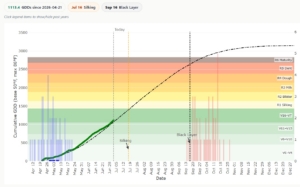
As of July 29th, we have accumulated approximately the following for Growing Degree Units in 2026:
Planting Date GDD’s2026 Average GDD Departure from 30-yr average 2025
April 16 1853 1663 +208 (+10 days) 1787
April 21 1818 1633 +185 (+8 days) 1754
April 25 1749 1604 +145 (+6.5 days) 1720
May 1 1734 1565 +169 (+7.5 days) 1674
May 8 1689 1503 +186 (+8 days) 1591
As we have been for much of the growing season, GDU accumulation continues to run ahead of normal and we have gained 2+ days since the last GDU update on July 17. Based on the above numbers and with continued normal-to-above normal temps for the rest of the growing season, we would need 40+ days to reach maturity for a typical 113-114 day hybrid (2700 GDU to physiological maturity) planted April 21st, which would put a potential black layer around the second week of September. 105-110 maturity would black layer during the first week of September. These projections are based off of total GDU listed for specific hybrids to reach maturity.
These are just projections….and projections are just that….projections. The likelihood of this occurring as mentioned above is not great, but it does give us a sense of just how fast the crop is moving along…which is normally not a positive to final yield, as this shortens the grain-fill period, which leads to reduced kernel depth and lower test weights.
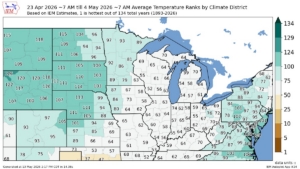
The maps and graph below give us a greater sense of why the GDU accumulation is happening like it is….
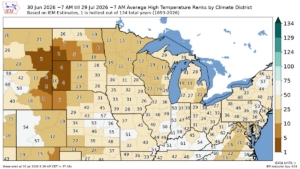
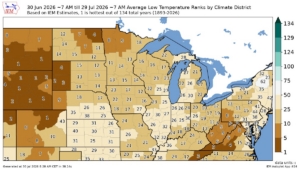
The two maps show the average high and low temperature ranks by climate district for the last 134 years. For average high temperatures, 2026 is ranked as the 31st hottest July for high temperatures out of the last 134 years. For average low temperatures, 2026 is ranked as the 17th hottest for average low temperatures out of the last 134 years. Restated in another way, only 16 years out of the last 134 years have been seen warmer average low temperatures in July than 2026.
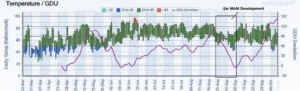
The graph below shows this in another way.
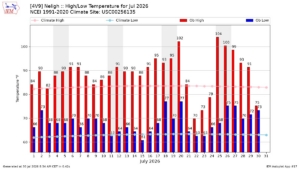
The graph shows daily high/low temperatures for July at Neligh, NE, along with the 30-year average for both. Note the departure from average for both high and low. July had 24 days above normal high temperature and 26 days above normal low temperatures….this is why GDU accumulation (stage-of-growth) is so far above normal….this is enhanced due to the April planting dates for both corn and soybeans. Bottomline is, we need the temperatures to cool off some over the next few weeks, so that the grain-fill period can be extended….best yields come from an extended grain-fill time….all else being equal, of course.
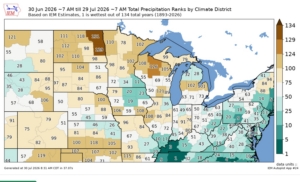
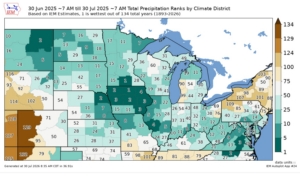
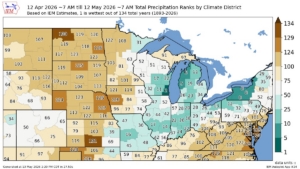
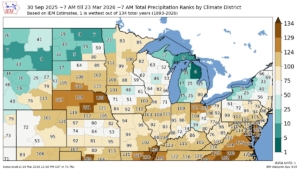
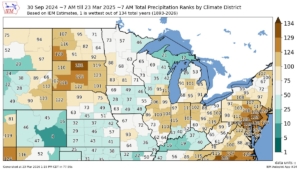
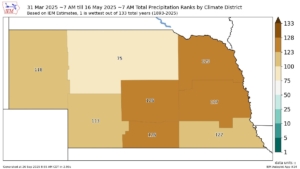
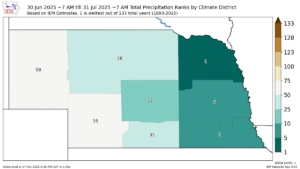
Last comment on current conditions….the above maps show the total precipitation rank for July 2026 and 2025. Note the big difference in just two years. From the 2nd wettest out of 134 years in 2025 to the 100th wettest July in 2026. Big swing, this will impact N-efficiency, rooting depth & overall rootzone mass, and disease development between the two years.
WHAT’S GOING ON IN MY FIELD?…..Corn Development, Disease, Crop Water Use..
Most of the corn crop is in the early-R3 (Milk) to R3 (Milk) stage. This matches the above GDU numbers, as this is 7-9 days ahead of normal and 4-5 days ahead of 2025, which was also slightly above normal.
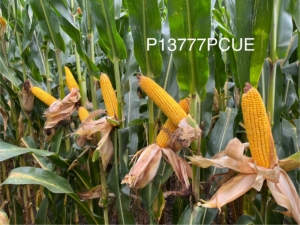
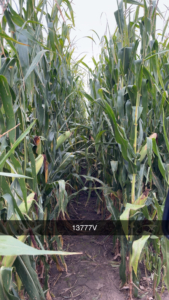
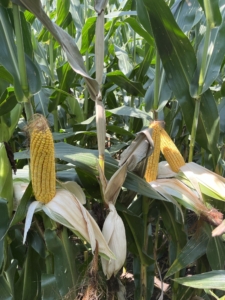
- Pollination overall seems to be good so far. Finding the usual checkerboard pattern of missing, or late pollinated kernels, on the butt of the ear, or scattered on the ear, but overall looks good. Rows around look to be normal by hybrid as well.
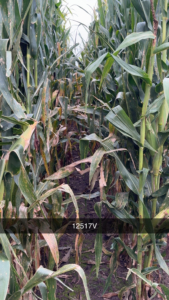
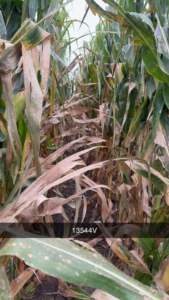
- Plant height this year is taller than a year ago, even the light sand is taller than last year. While there are differences in plant height within a field due to heavy crop residue and/or rye cover spots, and/or dry conditions during and after planting, overall field uniformity for plant height and color is good.
- Kernel abortion from stress can occur through the Milk stage(18-22 days after silking), however when the plant reaches Dough, kernel abortion will no longer take place, and any yield reduction from then on out will be from lower test weight. We are currently in the ‘tip-back’ stage of growth. This stage will last over the next two weeks or so. Temperature, sunlight and moisture play a role here….currently, drought conditions will have the greatest impact overall here.
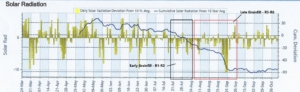
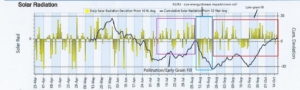
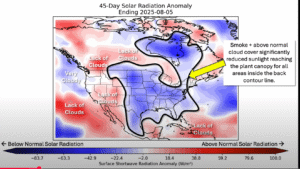
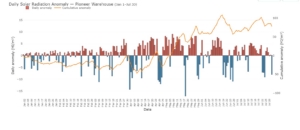
- As far as sunlight is concerned, we are trending above normal. Sunlight, of course, is now a much bigger yield factor, since we are now in the crucial grain-fill period. As such, how much sunlight, and when it occurs during the grain-fill period, will play a role in overall yield and late-season plant health. Lack of sunlight early in the grain fill period (i.e. right now) can increase potential for the ear to tip-back. Extra stress will occur if sunlight is reduced and temps (especially nighttime) are higher than average (so far, we have had good sunlight in this time of high nighttime temps). This stress occurs because, since temps are high (especially nighttime temps), the energy demand on the plant is higher than average. Couple this with reduced photosynthesis, and this leads to greater energy in the plant just going to maintain itself and not to filling the ear. It is an axiom in corn production that when you have to run your air conditioner at night, it is not good corn growing weather. See graph below for sunlight for Elgin, NE in 2026. Note that we have had good sunlight so far since pollination….
-
- Relative Humidity for most of July has been average to slightly-below average. It is only the past 7 or so days that RH had been above normal. The lower humidity helped to slow disease development, but raised ET rates. However, the higher humidity as of late is doing the opposite….increasing potential for disease development, but lowering overall ET rates.
- Currently, corn leaf disease has been on the low side for much of the area. We expect this to change over the next week or so due to the higher humidity, and if temps cool down.
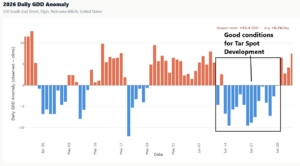
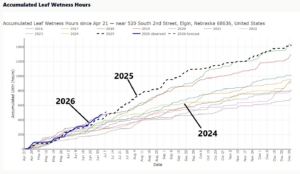
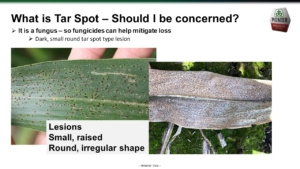
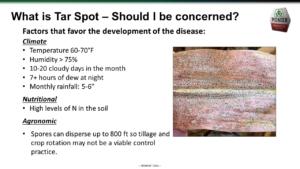
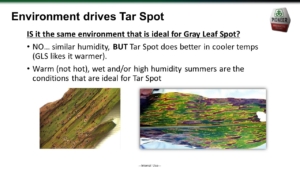
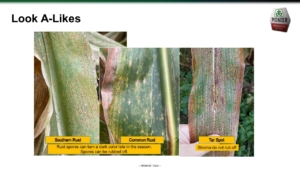
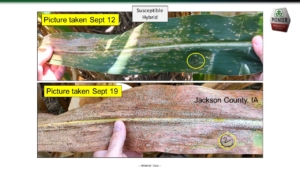
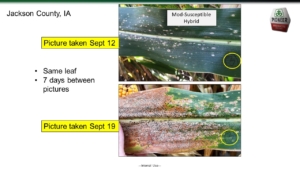
- Main leaf disease to currently watch for is Tar Spot. This disease is just starting to increase in severity, and we are seeing the heaviest levels in the Bartlett area so far. This disease is still an ‘unknown’ quantity for its overall impact, especially in the dry and hot conditions we have had over the past weeks. However, it can be a ‘fast mover’ once it gets established, and heavy irrigation can play a role by increasing development. Northern Corn Leaf Blight is more noticeable this year in most fields due to the cool and wetter conditions of late-June. If temperatures cool off for August and September, this disease will likely ‘get going’ again. So far, we have not observed Southern Rust in our area, but it has been confirmed in the counties to the south and west of us. Keep monitoring for leaf diseases, (even if field is already treated) over next few weeks for sudden outbreaks….
- Fungicide applications should be on, or going on now. Reminder, a fungicide will not help control Goss’s Wilt or Bacterial leaf streak. We will soon reach the time for a second treatment if one is planned…especially if the 1st treatment went on mid-July.
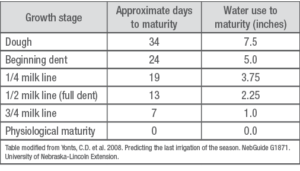
- ET Rates: Corn at Blister Kernel is average of .28/inch per day and Milk stage is .25″/day in normal weather….we are closer to .30+/day when hot & windy. It has been hard to keep up irrigating in almost all soil types over the past two weeks. However, some areas have received MUCH needed rain today, hopefully the whole area will receive a nice, general rain….
- All things consider, much of the irrigated crop is in good shape…and even the heavy ground dryland has been hanging on relatively well….
SOYBEAN UPDATE
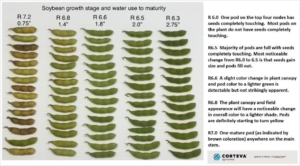
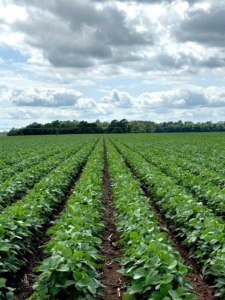
- Much of the crop is in the late-R2(full flower) to R3(pod set) to late-R4(full pod) stage-of-growth, depending upon planting date and variety maturity. Much like last year, overall stage-of-growth is ahead of normal. Overall plant height will be average to tall…the beans have really taken off as of late. Keep this in mind when irrigating….already starting see some lodging in spots….
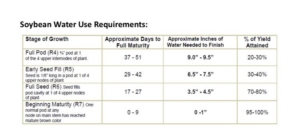
- Peak water use, nutrient demand, and overall energy demand in the plant occurs at R3 and into R4 stage….i.e. right now and into the next couple of weeks!
- ET rates in soybeans reach peak at R3 into R4 stage (.30+ in/day) and will continue to stay high through R6(full seed). Soybeans have been ‘pulling’ just as hard as corn over the past couple of weeks. See comments above on corn ET rates, as the same applies for soybeans. One will need to be careful not to water constantly to help reduce disease potential (see below on white mold) due to a constantly ‘wet canopy’. Potential for a heavier outbreak of white mold has grown with the recent foggy mornings and higher humidity over this past week. If White Mold becomes a problem, it will be best to water at night and leave off during the day so the canopy has some chance to dry out. In heavy soils, when irrigation is needed, we recommend running a heavy irrigation amount (.80 to inch+) and then leaving it sit for a while.
- We are just starting to see the first signs of White Mold in a few area fields. Weather conditions over the past week have been conducive for increasing development of this disease. How much this disease will impact this year’s crop is unknown, however, if the high humidity of the past week stays through most of August, this will greatly increase the potential for this disease….lodged beans will also increase the likelihood of this disease as well. Any second treatments for White Mold should really be on by now. See the attached link for White Mold management. Managing White Mold in Soybeans High temps and dry mornings will slow the disease down.
- Sudden Death Syndrome – so far not seeing much for SDS in area fields. We would expect to see more of this show up as the weeks progress. Soil conditions at planting were conducive for development of this disease. Soybean SDS Management
- We are also seeing first signs of Frogeye in soybeans….just a lesion or two. Keep an eye out for potential increase in this disease under these humid, wet conditions.
INSECT UPDATE – Corn & Soybeans
- Western Bean Cutworm numbers are low this year. They can be found in sandy fields, but overall infestation levels are low versus what we have seen in prior years. Any treatments now will be strictly rescue…
- We are just starting to see 2nd brood ECB moths start to fly. Keep this insect in mind on your conventional and popcorn acres over the next two weeks….
- Overall insect pressure in soybeans has been very light. Very little defoliation going on yet. Begin scouting for Bean Leaf Beetles as they will begin feeding on developing pods over the next few weeks. So far we are not finding any Soybean Aphids. If you have made an insecticide application already, or are going to, this should give you season long control unless a severe outbreak of one of these insects occurs.
- Dectes Stem Borer – be on the lookout for this insect starting now and into harvest. We have seen the adult beetles in some area fields over the past few weeks….actually pretty heavy amounts of adults overall. Watch field edges first and let us know if you are seeing wilted and dying plants, as they move in from the grassy edges. If you see this, keep these fields in mind for earlier harvest. Dectes Stem Borer in Soybeans
- Beginning to find a few small colonies of Corn Leaf Aphids (dark green aphid) in area corn fields. They tend to proliferate under cooler and damper conditions, so numbers should be on the low side….unless August turns cool and wet.
- So far just starting to see a few areas of Spider Mite colonies. Expectations are for this insect to increase in numbers over the next several weeks due the hot, dry conditions we have had, and if the hot, dry weather stays. Watch closely those fields that were treated with an insecticide over the recent weeks.
Please mark your calendar for the Pioneer Annual Customer Appreciation Supper, which is set for Friday, August 21st. Invite will be coming out soon! The Pioneer Plot Tour is tentatively set for Wednesday, September 2nd.
Please contact us with any questions or comments you may have! Thank you for your business!!
Starman Seed & Supply, Inc.