AGRONOMIC UPDATE: July 22, 2025….Quick update….
TOPICS FOR THIS UPDATE:
- Temperatures & GDU accumulation update
- Fungicide/Diseases in Corn/Soybeans
- Insect Update
TEMPERATURES & GDU ACCUMULATION:
As of July 21st, we have accumulated approximately the following for Growing Degree Units in 2025:
Planting Date GDD’s2025 Average GDD Departure from average
April 17 1570 1506 +64 (+2.5 days)
April 24 1518 1463 +55 (+2 days)
May 1 1472 1415 +57 (+2 days)
We have slipped a little since last update, but still just ‘a tick’ above normal and slightly behind 2024. Forecasts for the upcoming 10 days are for warmer than normal temperatures….we could use some of this….and more sunshine….
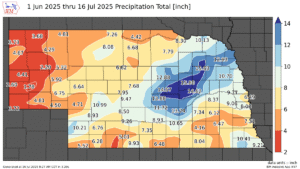
The above map is precipitation totals in inches for Nebraska from June 1 through July 16. Note that what was once the bullseye of the drought map in May is now the deep blue for precipitation. Since June 1, our area has received 200-300+% of normal rainfall. All of this has been a blessing considering how desperate we needed rain this past spring. However, there is truth in the statement….one can receive too much of a good thing…it becomes problematic to receive that much rainfall in a short time for N applications and leaching, lack of soil oxidation, and increased chances for storm damage.
- Cooler conditions over the past month has led to slower tassel emergence and a later pollination window versus last few years.
- Keep in mind that tassel has to be dry to shed full pollen, with peak pollen shed from 10am-2pm. Crop canopy has stayed wet through noon for the past week and I can’t help but think that hours of peak pollen shed are anywhere near normal over last few days. It is too early to determine how well the crop is pollinating, but early observations look good so far….
- Post-pollination N will start to go on next week. Considering the high rainfall amounts, you may want to think about adding an extra 20#s to your last application, especially if a heavy amount of N was applied with urea in June. Rainfall had to move N down somewhat and the root systems are not as deep as prior years.
FUNGICIDE/DISEASES IN CORN/SOYBEANS:
- Overall leaf disease infestations are low, other than some bacterial leaf streak. However, we have seen our first Tar Spot lesions. This is about 2-3 weeks ahead of 2024. This means that this disease will get off to a faster start than last year, and environment as-of-late has been very conducive for the development of this disease.
- Depending upon silk timing, fungicide applications should be going on now and through next week for best timing of control. Not all fungicides are equal when it comes to Tar Spot control. Keep this in mind when choosing which fungicide to use. See the following link for efficacy: 2025 Corn Foliar Fungicide Efficacy Chart
- Environmental conditions have been, and currently are, conducive for heavy disease outbreaks….highly recommended to apply a fungicide this year.
- The same goes for soybeans. Environmental conditions have been almost perfect for a significant white mold outbreak. Applications for 2nd treatment should be on by August 1st. Most bean fields will be into R3 (pod set) by that time, if not getting there already.
INSECT UPDATE:
- So far WBC infestation levels have been low, but enough to ‘clean up’ fields….most levels at 2-6%…an odd 8-10% in spots. Moths are still flying and will continue to do so for next 7 days in significant numbers. Treat as soon as field is 95% tasseled. See video: Newly hatched WBC larvae in tassel
- Corn rootworm levels have been higher than expected considering the low numbers seen in 2024. We are seeing higher numbers of adult beetles, though not as heavy as some past years. Any beetle control for potential silk-clipping should be on, or going on now.
- So far very little insect activity in soybeans….hope it stays that way….
LUMIDERM SxS
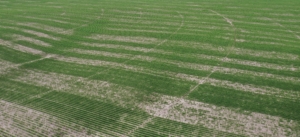
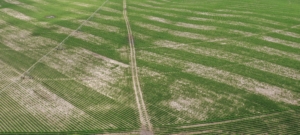
- The above photos are from the same field. Split planter of same soybean variety (P28Z30E) with two different seed treatments. One side of the planter with Lumiderm insecticide and the other side without Lumiderm. The good rows in the photos had the Lumiderm. This field was tilled-ground and heavily pastured all winter, with late removal of the cattle this spring…sandy soil. We saw excellent protection from the Lumiderm on seedcorn maggots, etc.
- The past few years we have seen increased stand loss on tilled-soybeans in sandy soils from seedcorn maggots. Lumiderm offers added protection for this pest. We treated a lot of tilled-acres this year with Lumiderm and saw good results….though nothing as dramatic as this field!
Please mark your calendar for the Pioneer Annual Customer Appreciation Supper, set for Friday, August 22nd. The Pioneer Plot Tour is tentatively sent for, Wednesday, September 3rd.
Please contact us with any questions or comments you may have! Thank you for your business!!
Starman Seed & Supply, Inc.