
AGRONOMIC UPDATE: May 13, 2026….Planting Update….same but different….
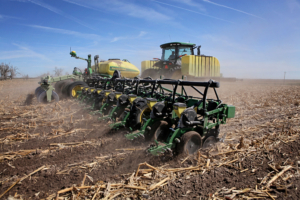
2026 planting season and early conditions….some same (dry) as 2025….some different (colder) than 2025….
TOPICS FOR THIS UPDATE:
- Temperatures & GDU accumulation
- Planting conditions, emergence & Frost….
- Insect Update
TEMPERATURES & GDU ACCUMULATION:
As of May 13th, we have accumulated approximately the following for Growing Degree Units in 2026:
Planting Date GDD’s2026 Average GDD Departure from average 2025
April 16 242 215 +27 296
April 21 199 185 +14 241
April 25 139 156 -17 228
May 1 130 116 +14 183
PLANTING CONDITIONS AND EMERGENCE….
The GDU accumulation numbers clearly show three distinct planting windows this season:
- First window: April 14–23
- Second (mid) window: April 24–May 4
- Third window: The last 7–9 days
This pattern is reflected in the data, with above-average GDU accumulation during the first and third windows, but below-average accumulation during the mid-planting window. When we compare this to 2025, the differences are significant. Even though 2026 is running above average overall, 2025 had substantially more GDU accumulation and much better heat across the same time period. While dry conditions were similar last year, we experienced more consistent soil temperatures and stronger heat in 2025, something that we have bnot had in 2026. This year, the soil still feels cold under residue in many areas. The old adage “no two years are alike” is certainly holding true again.
To summarize:
2026 Planting Windows (GDU Patterns)
- Early window (April 14–23): Strong above-average GDU accumulation → best start, more advanced development.
- Mid-window (April 24–May 4): Below-average accumulation → slower emergence, vegetative lag, and potentially uneven stands.
- Recent/late window (roughly May 5–14): Another solid push of GDUs helping later plantings catch up somewhat.
Management Takeaways for 2026, especially as we are now getting the heat we need (wish it was with rain!)
- Early-planted fields (April 14–23): Likely ahead — monitor for rapid growth and potential nutrient demand.
- Mid-planted fields: Watch closely for uneven emergence and consider sidedress timing adjustments.
- Late-planted fields: Recent heat helps, but they’re still playing catch-up.
The map below puts this in perspective:
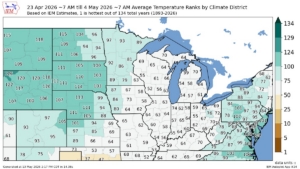
This map is showing average temperature rank by climate district from April 23-May 4 for 2026. Note that NE Nebraska climate district shows we were the 35th coldest during this period in the last 134 years….much cooler during this time period in 2026 than last year. In fact, the week of April 26th to May 2nd saw a total of 12 GDU’s accumulated (4 days had zero) with soil temps getting into the upper 30’s by the end of that week and at least three frost/freezes over this time period. Big reason why we were trying to hold off on planting after April 25th. While this does not seem to be a big impact on final plant stands, it will lead to some reduction in overall stands and impact how even of emergence we will see on these planting dates….for both corn and soybeans. The early planted crops, for the most part, look good as they got germinated in warm soils….the last planted crops will also be germinating in warm soils.
Dry soils are also playing a role here. See map below:
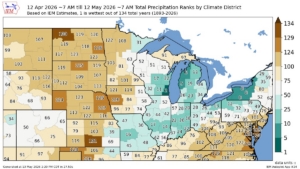
This map is showing average precipitation rank by climate district for the past 30 days from April 12 to May 12. Note that NE Nebraska has had the 10th driest year out of the past 134 years….we are seeing historical drought conditions this planting year, much like last year.
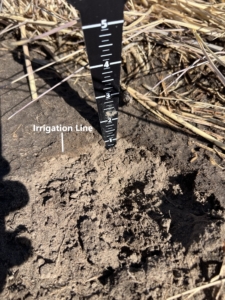
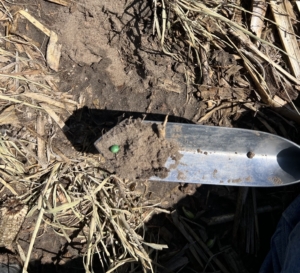
These two photos show some of what is happening from the dry conditions and low humidity we are experiencing. Photos from soybean field planted 5/1 in sand.
FROST….
However, the first planted beans were not immune to some freeze damage. See photos below.
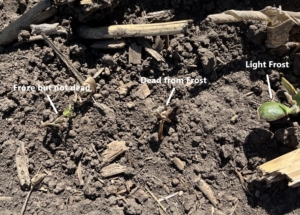
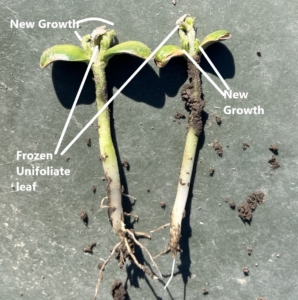
The first photo is from a field planted 4/16-17, with low elevation. Note that the three plants have varying stages of frost damage…plant on left was frozen, but not dead and has new growth….middle plant is dead….plant on the right slightly frosted with new growth. This was common throughout this field. Second photo is from field planted 4/15-16 but sits on a higher elevation. Frost damage here as well, but limited to the unifoliate leaf that was emerging at that time. Note the new growth starting. Those plants showing new growth should be fine; however, we have seen plants like the one on the far left in the first photo, not come back quite like a normal plant, just ‘off’ a bit. Some fields may show 1-5% stand loss from the multiple freezes we experienced, especially in the bottom areas.
Early planted corn also had leaf damage from the freezes. See photo below:
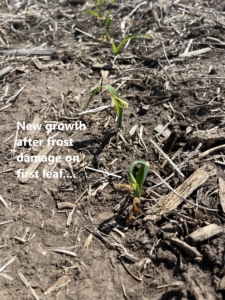
This field was planted on 4/14-15…a lot of plants had the emerging first growth killed by the freeze, however, note the new growth coming through (still tangled a little in the dead tissue, but will break free). No issues here.
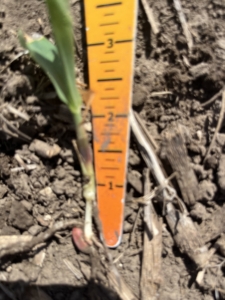
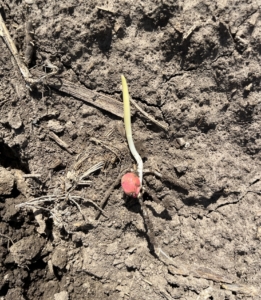
These two photos are from the same field as the frost picture above, planted 4/14-15. The field has nice stand of 32-34k, but they show some of the effects from our dry spring and winter….harder soil conditions in many spots, leading to less than 2″ planting depth….a few delayed emerging plants from the dry conditions and less than ideal seed-soil contact….
Bottomline, the 2026 planting season has seen weather extremes in temperatures and dry conditions, all of which are creating challenging conditions for quick & even emergence, for both corn and soybeans.
Herbicide Activity….
Good weed control starts with good residuals…AND keeping them in soil solution is an key part of how well they perform. Unfortunately with no rainfall, it will be important to water these fields on a regular basis (once-a-week minimum) to get adequate performance. In those years we saw pre’s work the best is when we were getting .30 every other day…
INSECT UPDATE
So far not seeing much in the way of insects causing an issue with emergence….some seedcorn maggot feeding in a few soybean fields.
Please reach out to us with any questions and/or observations! Stay Safe!
Starman Seed & Supply, Inc.