Topics:

– Temperatures & GDU Accumulation

– Corn Update/Water Usage/Weather Update

– Corn/Soybean Insect Update

TEMPERATURES & GDU ACCUMULATION:

As of August 19th, we have accumulated approximately the following for Growing Degree Units in 2025:

Planting Date     GDD’s2025          Average GDD         Departure from average

April 17                  2247                           2089                              +158 (+8 days)

April 24                 2196                           2043                               +153 (+8 days)

May 1                     2149                           1996                                +153 (+8 days)

We have seen a big increase in GDU accumulation since the last update on August 3rd.  We are now ahead of normal by just over one week.  This is reflected in the current corn crop’s stage-of-growth versus this same time last year, as will be noted below.   At this time last year, we were right at the normal for GDU accumulation.  However, this increase in GDU accumulation has come with a potential cost, as most of the reason for this has been higher than normal nighttime temperatures….more on this below in corn discussion.

Forecast next 7-14 days:
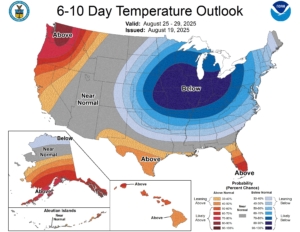
                   

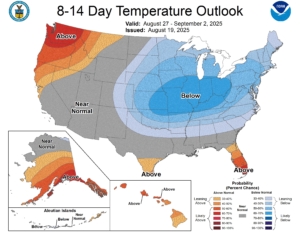
The above maps are 6-10 and 8-14 day temperature outlooks – August 19 forecasts.  We usually hesitate to post these as they seem to changed day-to-day.  However, most weather forecasts are very consistent in these maps with trend for this to continue through the rest of August and into early September.  What this means, if this comes occurs, is that we will lose the gain we show from the above numbers.  The good from this is that crop development will slow down some allowing for longer grain-fill period.  The negative from this will come from just how long this cool period lasts.  The longer it lasts, usually means lower test weights, especially if occurs with reduced sunlight.  Disease development will also be impacted as Southern Rust will slow down, but increased potential for Northern Corn Leaf Blight will grow substantially. As usual, what is gained from a change in environment leads to increased potential for something else to occur….overall this is not a forecast to add bushels to the corn crop….

CROP UPDATE/WATER USE/WEATHER UPDATE
  • Crop conditions: Much of the Corn crop in the area is in the Beg. Dent to Full Dent to 1/8 milk line on some hybrids.  L:ast year at this time, corn was Late Dough to Beg. Dent, so we are currently ahead of 2024.   Soybeans are ahead of last year, mainly due to the early planting and the amount of acres planted before May 1.  Early soybeans are in the R6-R6.5(full seed), with May planting dates in the R5-5.5(Beg. Seed) stage.  These stages-of-growth track with the above GDU accumulation of one week ahead of normal.
  • The hybrids that we currently plant today, perform best with a long grain-fill period….they still need four weeks of fill once crop reaches full-dent for highest test weights, kernel depth, and good late-season plant health.
  • Relative Humidity – Over the past two weeks, RH has been running above normal, in fact 8-10% above normal.  Average RH has been mid-70’s t0 mid-80’s.  This is higher than 2024.  Higher RH usually mean lower ET rates.  Higher overall RH though, usually has a negative impact on disease.  However, temperatures, winds, rainfall, all play a role here as well.
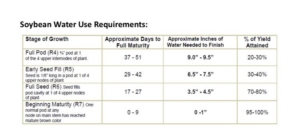
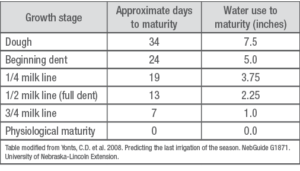
  • ET rates – ET rates over the past 7-10 days have been the highest we have had so far this summer; however, due to the high RH, they are still trending below the average by .05/day.  Soybeans were actually pulling harder than corn over the past two weeks.  The cool temperatures forecasted for the rest of August will dramatically lower ET rates.  Keep this in mind as you think about irrigation over the next 7-10 days.  See tables below for Water Use for soybeans and corn as we head into the main part of grain fill period.  Corn and soybean needs are still for 4-8″ to finish depending upon planting date and stage-of-growth.  Right now we are in a much different place than this time last year, where August and September were warmer and dryer than normal….
  •          
  • Sunlight – As always sunlight becomes a major player during grain-fill for both yield and late-season plant health. 
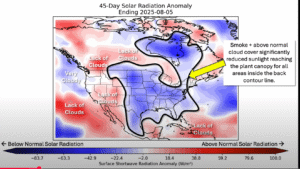
  • The above map shows the solar radiation anomaly for the past 45-days.  While this map is just one data-set, it does show a general trend of lower sunlight for July and first part of August.   That trend has continued through the current month.  We always stress how important sunlight is for kernel depth and test weights, but it plays a big role in overall plant health.  Compared to 2024, August of 2025 is trending behind….hopefully this changes as we get into September.
  • Diseases – So far the 2025 growing season has caused our fields to be a petri dish for disease development, especially corn fields.  We continue to see Southern Rust progress in area fields, even in those fields which had a fungicide applied to them.  However, there are very noticeable differences in disease levels between treated and untreated, with untreated fields showing much heavier disease pressure than treated fields.  Also, expect overall fungicide control to be more variable this year compared to last few years due to environment, application timing and coverage.  We will know more on how well fungicides performed over the next couple of weeks.
  • We continue to monitor for Tar Spot.  We continue to see this disease show up in higher levels than last year, but we are not seeing it just ‘blow up’ yet.  Greatest impact from this disease will most likely be on late-season standability.  We will update for any impact on harvest as the growing season progresses to the finish line.  As mentioned above in the temperature comments, keep an eye out for increased Northern Corn Leaf Blight lesions.  While normally not much of an issue for us in our warmer climate, the forecasted temperatures are conducive for this disease to increase.  Starting to see some Goss’s Wilt show up in the hailed areas.  Bottomline, disease will impact both final yield and harvestability for 2025.
  • For Soybeans, we are just now seeing a little White Mold show up in some fields.  Overall levels of this disease are very low considering the growing season so far.  This disease should not be an impact on irrigation management.  However irrigation management moving forward in soybeans this year, will have more to do with lodging than disease.    SDS is showing up in our area once again.  We continue to see increased levels of this disease each year.  Monitor fields for this disease and plan on seed treatment for next year in those fields showing high pressure.   In general though, overall disease in soybeans is low….

CORN/SOYBEAN INSECT UPDATE

  • Spider Mites – Currently we are finding spider mite colonies in many area fields, very low numbers overall.  However, in conventional corn/white corn/popcorn fields are showing up with higher numbers due to earlier treatments for corn borer and western bean cutworm.  The forecasted cooler temps should really slow this insect down.
  • Corn Leaf Aphids – We are seeing higher numbers of Corn Leaf Aphids in most corn fields.  They proliferate in high humidity conditions.  They are not a cause for concern….just more of a nuisance when walking through fields.
  • Western Bean Cutworm – We are still seeing low numbers of larvae in ear tips on those fields not treated.  While overall numbers have been low, they are still present in some areas.
  • Soybean pests – so far, insect activity in soybeans continues to be very light.  We are seeing some soybean aphids, but low numbers overall.  Expectations for major outbreaks of these pests are low….or, really outbreaks of any kind in soybeans at this stage.

Video of Interest…..Rat Tailing in Corn – Local Observations….

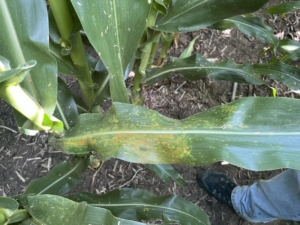
We are seeing a little of this in area fields.  Two things can cause this type of injury….herbicide (specifically growth regulators) or mechanical injury such as hail, wind (think of those days in mid-late May that were so windy), plant being driven over, etc.,….these can cause injury to the growing point.  Most of what we see leads us to think herbicide….

If you find these symptoms in your field, look up spray dates, weather conditions at time of spraying, herbicide rates used, etc., to see if any pattern develops.  Hybrids differ in there tolerance to growth regulators as well.  Not a big factor, just observations….

Reminder that the Pioneer Customer Appreciation Supper is this upcoming Friday evening, August 22nd.  Pioneer warehouse – Elgin, NE….5:30-8:30.   Bring the family!   See you there!

Plot tour is scheduled for Wednesday, September 3rd….

All for now!  Thanks for your time!
 

Topics:

– Growing Degree Day Update

– What’s going on in my fields?…..Corn Development, ET rates, Disease, etc. 

– Insect Update

– Soybean Development

TEMPERATURES & GDU ACCUMULATION:

As of August 3rd, we have accumulated approximately the following for Growing Degree Units in 2025:

Planting Date     GDD’s2025          Average GDD         Departure from average

April 17                  1872                           1766                                +106 (+4 days)

April 24                 1821                           1720                                +101 (+4 days)

May 1                     1773                           1673                                +100 (+4 days)

From the above numbers, you can see that we have gained a couple of days over the past two weeks.  While the past week has been cool, the third week of July was above normal temps.  So, even though it doesn’t feel like we should’ve gained anything versus normal over the past two weeks, numbers say otherwise.  Based on the above numbers and planting date, need another 40-45 days to reach maturity for average 111-114 day hybrids with normal temperatures….there is still a lot of growing season left that is critical to final yield.  More on this in the maps below…

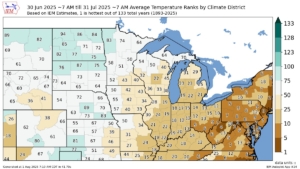
The above map is the average temperature for July 2025.  Note that July’s temperatures have been about as ‘average’ as you can get over the past 133 years…..not too hard to see why the year has been very average for GDU accumulation.

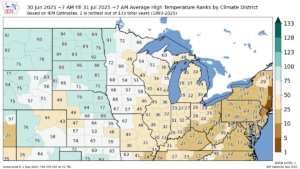
The above map is the average high temperature rank for July 2025.  Here we see the coolness that we are experiencing.  No stress, but doesn’t ‘move things along’ so well…


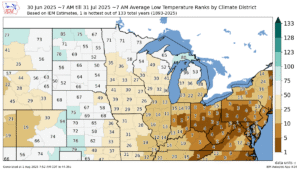
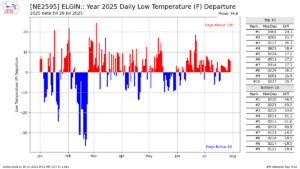
The above map is the average low temperature rank for July 2025 and the graph is the daily love temperature for Elgin for the whole of 2025 so far this year.  In the map, note that we have had higher low temperatures for July and for most of the growing season from the graph.  This is what is keeping our GDU accumulation normal….however, this comes with a cost, as higher nighttime temperatures mean higher plant respiration, which is a negative to plant development and a stress inducer…keep all of this in mind for final kernel count, weight and impact on late-stalks as the rest of the growing season plays out.

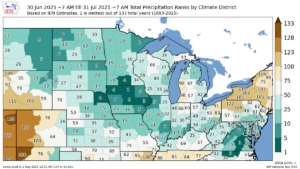
Last comment on current conditions….the above map is the total precipitation rank for July 2025.  Note that July 2025 was the 4th wettest out of the past 133 years….we are ‘wet country’.  This has been a blessing, but like most things, one can have too much of a ‘good thing’.  Besides issues like delaying N applications/leaching and reduced soil oxidation, the wet conditions have increased humidity and turned our fields into petri dishes for disease.

WHAT’S GOING ON IN MY FIELD?…..Corn Development, Disease, Crop Water Use..

Most of the corn crop is in the early-R3 (Milk) to R3 (Milk) stage.  The heat on the last weekend in July helped move the crop along.  As noted above, the crop has continued to develop in these cooler conditions.

  • Pollination overall seems to be good so far.  Finding the usual checkerboard pattern of missing, or late pollinated kernels, on the butt of the ear, or scattered on the ear, but overall looks good.
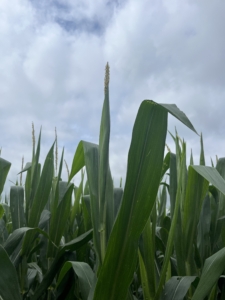
  • Tassel Wrap.  The above photo shows what has been called this year, tassel wrap.  This is where the last leaves of the plant stay ‘wrapped’ around the emerging tassel, delaying full tassel emergence, and thereby, pollen shed.  This phenomenon has been observed across the cornbelt and we saw some of this here as well.  However, we have yet to see where this played a huge role in pollination.  As always, please let us know if you see any issues in your fields.  The following link is a good summary of this phenomenon.
  • Wrapped Tassels In Corn
  • Plant height this year is across the board….shorter in the sand.  The very windy conditions experienced in mid-late May impacted this greatly.  Rows around on the ear were being developed when the windy conditions occurred as well…we are thinking some of these fields were impacted by reduced rows around in some cases…from 16-18 rows average to 14-16 rows….
  • At R1, potassium uptake is essentially complete, and nitrogen and phosphorous uptake are rapid.  Last round of N should be on, or getting on now….   
  • Blister Kernel occurs approx. 10-14 days after Silking.  Starch has begun to accumulate in the watery endosperm and the kernels are beginning a period of rapid, steady, dry matter accumulation that will continue until physiological maturity in approx. 50-60 days after silking.
  • At Blister Kernel, maximum ear length is achieved.  Although not as severe as at Silking, stress over the next two weeks can still have a profound effect on yield through kernel abortion….think higher nighttime temps here….
  • Kernel abortion from stress can occur through the Milk stage(18-22 days after silking), however when the plant reaches Dough, kernel abortion will no longer take place, and any yield reduction from then on out will be from lower test weight.  We are currently in the ‘tip-back’ stage of growth.  This stage will last over the next two weeks or so.  Temperature and sunlight will play a role here….potential for increased ‘tip-back’ is higher this year versus past years due to temps and reduced sunlight.
  • As far as sunlight is concerned, we are currently trending below normal over the last month.  Sunlight, of course, is now a much bigger yield factor, since we are now beginning the crucial grain fill period.   As such, how much sunlight, and when it occurs during the grain-fill period, will play a role in overall yield and late-season plant health.   Lack of sunlight early in the grain fill period (i.e. right now) can increase potential for the ear to tip-back.  Extra stress will occur if sunlight is reduced and temps (especially nighttime) are higher than average.  This stress occurs because, since temps are high (especially nighttime temps), the energy demand on the plant is higher than average; couple this with reduced photosynthesis, and this leads to greater energy in the plant just going to maintain itself and not to filling the ear.  It is an axiom in corn production that when you have to run your air conditioner at night, it is not good corn growing weather.
  • Beginning about mid-June, Relative Humidity has been above normal, with a daily average RH in the low-to-upper 70’s%.   While this leads to decreased ET rates; it increases the potential for more disease in corn and soybeans.
  • We are seeing an increase in leaf diseases in corn from just this past week. For one, we are seeing first signs of Southern Rust lesions in some area fields.  not heavy yet, but present.
  • This disease can ‘blow up’ quickly, so highly recommended to watch your fields for outbreaks….better yet,  we recommend to apply a fungicide to halt the disease if not already done so.  We are finding it heavier in untreated vs. treated fields at present.  We continue to see Tar Spot, Grey Leaf Spot and Northern Corn Leaf Blight slowly increase in area fields as well.  Keep monitoring for leaf diseases, even if field already treated, over next few weeks for sudden outbreaks….
  • Fungicide applications should be on, or going on now.  You want to protect the plant when it is working the hardest, which is silking through milk stage (which is  NOW!).  Reminder, a fungicide will not help control Goss’s Wilt or Bacterial leaf streak.
  • With all of the rain, it has been easy to lose track of ET rates.  Corn at Blister Kernel is average of .28/inch per day and Milk stage is .25″/day in normal weather….we are closer to .30+/day when hot & windy.  Overall ET rates have been below normal over past cool conditions but expect them to increase when heat returns later this week.

SOYBEAN UPDATE

  • Much of the crop is in the late-R3(pod set) to R4(full pod) stage-of-growth, to R5(Beg. seed) in the early-planted fields.  Considering how many acres of soybeans were planted by May 1st this year, stage-of-growth is ahead of normal.  Overall plant height will be average to tall…the beans have really taken off as of late.  Keep this in mind when irrigating….
  • Peak water use, nutrient demand, and overall energy demand in the plant occurs at R3 and into R4 stage….i.e. right now and into the next few weeks!
  • ET rates in soybeans reach peak at R3 into R4 stage (.30+ in/day) and will continue to stay high through R6(full seed).    See comments above on corn ET rates, as the same applies for soybeans.  One will need to be careful not to water constantly to help reduce disease potential (see below on white mold) due to a constantly ‘wet canopy’.   If White Mold becomes a problem, it will be best to water at night and leave off during the day so the canopy has some chance to dry out.    In heavy soils, when irrigation is needed, we recommend running a heavy irrigation amount (.80 to inch+) and then leaving it sit for a while.
  • We are just starting to see the first signs of White Mold in a few area fields.  Weather conditions of the past few weeks have been conducive for development of this disease.  How much this disease will impact this year’s crop is unknown yet, however, the high humidity of recent weeks will greatly increase the potential for this disease….lodged beans will also increase the likelihood of this disease as well. Any second treatments for White Mold should really be on by now.   See the attached link for White Mold management.    Managing White Mold in Soybeans    We recommend Aproach, Viatude, or Delaro fungicide for any white mold control.   High temps and dry mornings will slow the disease down.
  • Sudden Death Syndrome – so far not seeing much for SDS in area fields.  We would expect to see more of this show up as the weeks progress.
  • We are also seeing first signs of Frogeye in soybeans….just a lesion or two.  Keep an eye out for potential increase in this disease under these humid, wet conditions.

INSECT UPDATE – Corn & Soybeans

  • Western Bean Cutworm numbers are historically low this year.  They can be found in sandy fields, but overall infestation levels are low versus what we have seen in prior years.  Any treatments now will be strictly rescue…
  • We starting to see 2nd brood ECB moths start to fly.  Keep this insect in mind on your conventional and popcorn acres over the next two weeks.
  • Overall insect pressure in soybeans has been very light.   Very little defoliation going on yet.  Begin scouting for Bean Leaf Beetles as they will begin feeding on developing pods over the next few weeks.  So far we are not finding any Soybean Aphids.   If you have made an insecticide application already, or are going to, this should give you season long control unless a severe outbreak of one of these insects occurs.
  • Dectes Stem Borer – be on the lookout for this insect starting now and into harvest.  We have seen the adult beetles in some area fields over the past few weeks, actually pretty heavy amounts of adults as well.  Watch field edges first and let us know if you are seeing wilted and dying plants as they move in from the grassy edges.  If you see this, keep these fields in mind for earlier harvest.  Dectes Stem Borer in Soybeans
  • Seeing a few small colonies of Corn Leaf Aphids(dark green aphid) in area corn fields.   They tend to proliferate under cooler and damper conditions, so we may see them increase as time goes on.
  • So far just seeing a few areas of Spider Mite colonies.  If temperatures turn out as forecasted (cooler temps and higher relative humidity), infestation levels should be on the light side.  Rather surprised to see some in these conditions; however, keep an eye out for this insect over the next month or so.

Please mark your calendar for the Pioneer Annual Customer Appreciation Supper  which is set for Friday, August 22nd.  Invite will be coming out soon!  The Pioneer Plot Tour is tentatively sent for, Wednesday, September 3rd.

Please contact us with any questions or comments you may have!   Thank you for your business!!

Starman Seed Service, Inc.