Topics:

– Growing Degree Day Update

– What’s going on in my fields?…..Corn Development, ET rates, Disease, etc. 

– Insect Update

– Soybean Development

TEMPERATURES & GDU ACCUMULATION:

As of August 3rd, we have accumulated approximately the following for Growing Degree Units in 2025:

Planting Date     GDD’s2025          Average GDD         Departure from average

April 17                  1872                           1766                                +106 (+4 days)

April 24                 1821                           1720                                +101 (+4 days)

May 1                     1773                           1673                                +100 (+4 days)

From the above numbers, you can see that we have gained a couple of days over the past two weeks.  While the past week has been cool, the third week of July was above normal temps.  So, even though it doesn’t feel like we should’ve gained anything versus normal over the past two weeks, numbers say otherwise.  Based on the above numbers and planting date, need another 40-45 days to reach maturity for average 111-114 day hybrids with normal temperatures….there is still a lot of growing season left that is critical to final yield.  More on this in the maps below…
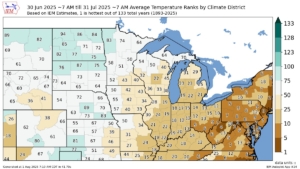
The above map is the average temperature for July 2025.  Note that July’s temperatures have been about as ‘average’ as you can get over the past 133 years…..not too hard to see why the year has been very average for GDU accumulation.
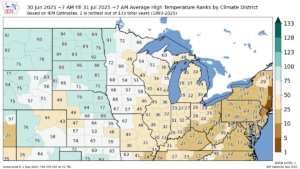
The above map is the average high temperature rank for July 2025.  Here we see the coolness that we are experiencing.  No stress, but doesn’t ‘move things along’ so well…
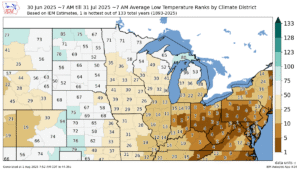
   

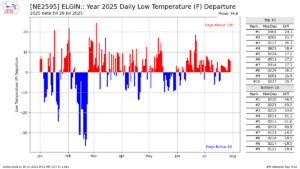
The above map is the average low temperature rank for July 2025 and the graph is the daily love temperature for Elgin for the whole of 2025 so far this year.  In the map, note that we have had higher low temperatures for July and for most of the growing season from the graph.  This is what is keeping our GDU accumulation normal….however, this comes with a cost, as higher nighttime temperatures mean higher plant respiration, which is a negative to plant development and a stress inducer…keep all of this in mind for final kernel count, weight and impact on late-stalks as the rest of the growing season plays out.
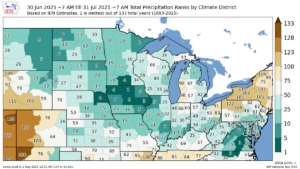
Last comment on current conditions….the above map is the total precipitation rank for July 2025.  Note that July 2025 was the 4th wettest out of the past 133 years….we are ‘wet country’.  This has been a blessing, but like most things, one can have too much of a ‘good thing’.  Besides issues like delaying N applications/leaching and reduced soil oxidation, the wet conditions have increased humidity and turned our fields into petri dishes for disease.

WHAT’S GOING ON IN MY FIELD?…..Corn Development, Disease, Crop Water Use..

Most of the corn crop is in the early-R3 (Milk) to R3 (Milk) stage.  The heat on the last weekend in July helped move the crop along.  As noted above, the crop has continued to develop in these cooler conditions.

  • Pollination overall seems to be good so far.  Finding the usual checkerboard pattern of missing, or late pollinated kernels, on the butt of the ear, or scattered on the ear, but overall looks good.
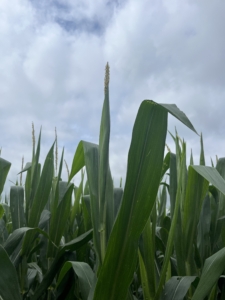
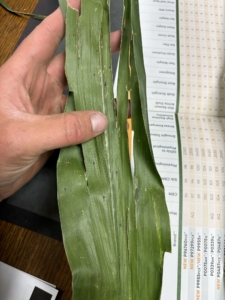
  • Tassel Wrap.  The above photo shows what has been called this year, tassel wrap.  This is where the last leaves of the plant stay ‘wrapped’ around the emerging tassel, delaying full tassel emergence, and thereby, pollen shed.  This phenomenon has been observed across the cornbelt and we saw some of this here as well.  However, we have yet to see where this played a huge role in pollination.  As always, please let us know if you see any issues in your fields.  The following link is a good summary of this phenomenon.
  • Wrapped Tassels In Corn
  • Plant height this year is across the board….shorter in the sand.  The very windy conditions experienced in mid-late May impacted this greatly.  Rows around on the ear were being developed when the windy conditions occurred as well…we are thinking some of these fields were impacted by reduced rows around in some cases…from 16-18 rows average to 14-16 rows….
  • At R1, potassium uptake is essentially complete, and nitrogen and phosphorous uptake are rapid.  Last round of N should be on, or getting on now….   
  • Blister Kernel occurs approx. 10-14 days after Silking.  Starch has begun to accumulate in the watery endosperm and the kernels are beginning a period of rapid, steady, dry matter accumulation that will continue until physiological maturity in approx. 50-60 days after silking.
  • At Blister Kernel, maximum ear length is achieved.  Although not as severe as at Silking, stress over the next two weeks can still have a profound effect on yield through kernel abortion….think higher nighttime temps here….
  • Kernel abortion from stress can occur through the Milk stage(18-22 days after silking), however when the plant reaches Dough, kernel abortion will no longer take place, and any yield reduction from then on out will be from lower test weight.  We are currently in the ‘tip-back’ stage of growth.  This stage will last over the next two weeks or so.  Temperature and sunlight will play a role here….potential for increased ‘tip-back’ is higher this year versus past years due to temps and reduced sunlight.
  • As far as sunlight is concerned, we are currently trending below normal over the last month.  Sunlight, of course, is now a much bigger yield factor, since we are now beginning the crucial grain fill period.   As such, how much sunlight, and when it occurs during the grain-fill period, will play a role in overall yield and late-season plant health.   Lack of sunlight early in the grain fill period (i.e. right now) can increase potential for the ear to tip-back.  Extra stress will occur if sunlight is reduced and temps (especially nighttime) are higher than average.  This stress occurs because, since temps are high (especially nighttime temps), the energy demand on the plant is higher than average; couple this with reduced photosynthesis, and this leads to greater energy in the plant just going to maintain itself and not to filling the ear.  It is an axiom in corn production that when you have to run your air conditioner at night, it is not good corn growing weather.
  • Beginning about mid-June, Relative Humidity has been above normal, with a daily average RH in the low-to-upper 70’s%.   While this leads to decreased ET rates; it increases the potential for more disease in corn and soybeans.
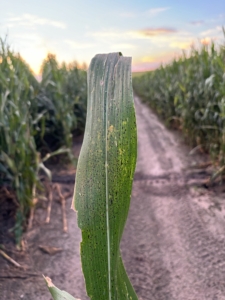
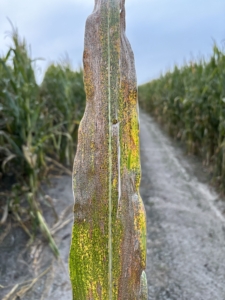
  • We are seeing an increase in leaf diseases in corn from just this past week. For one, we are seeing first signs of Southern Rust lesions in some area fields.  not heavy yet, but present.
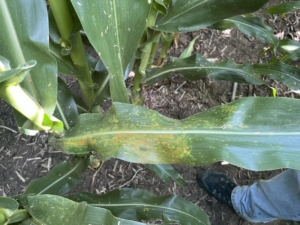
  • This disease can ‘blow up’ quickly, so highly recommended to watch your fields for outbreaks….better yet,  we recommend to apply a fungicide to halt the disease if not already done so.  We are finding it heavier in untreated vs. treated fields at present.  We continue to see Tar Spot, Grey Leaf Spot and Northern Corn Leaf Blight slowly increase in area fields as well.  Keep monitoring for leaf diseases, even if field already treated, over next few weeks for sudden outbreaks….
  • Fungicide applications should be on, or going on now.  You want to protect the plant when it is working the hardest, which is silking through milk stage (which is  NOW!).  Reminder, a fungicide will not help control Goss’s Wilt or Bacterial leaf streak.
  • With all of the rain, it has been easy to lose track of ET rates.  Corn at Blister Kernel is average of .28/inch per day and Milk stage is .25″/day in normal weather….we are closer to .30+/day when hot & windy.  Overall ET rates have been below normal over past cool conditions but expect them to increase when heat returns later this week.

SOYBEAN UPDATE

  • Much of the crop is in the late-R3(pod set) to R4(full pod) stage-of-growth, to R5(Beg. seed) in the early-planted fields.  Considering how many acres of soybeans were planted by May 1st this year, stage-of-growth is ahead of normal.  Overall plant height will be average to tall…the beans have really taken off as of late.  Keep this in mind when irrigating….
  • Peak water use, nutrient demand, and overall energy demand in the plant occurs at R3 and into R4 stage….i.e. right now and into the next few weeks!
  • ET rates in soybeans reach peak at R3 into R4 stage (.30+ in/day) and will continue to stay high through R6(full seed).    See comments above on corn ET rates, as the same applies for soybeans.  One will need to be careful not to water constantly to help reduce disease potential (see below on white mold) due to a constantly ‘wet canopy’.   If White Mold becomes a problem, it will be best to water at night and leave off during the day so the canopy has some chance to dry out.    In heavy soils, when irrigation is needed, we recommend running a heavy irrigation amount (.80 to inch+) and then leaving it sit for a while.
  • We are just starting to see the first signs of White Mold in a few area fields.  Weather conditions of the past few weeks have been conducive for development of this disease.  How much this disease will impact this year’s crop is unknown yet, however, the high humidity of recent weeks will greatly increase the potential for this disease….lodged beans will also increase the likelihood of this disease as well. Any second treatments for White Mold should really be on by now.   See the attached link for White Mold management.    Managing White Mold in Soybeans    We recommend Aproach, Viatude, or Delaro fungicide for any white mold control.   High temps and dry mornings will slow the disease down.
  • Sudden Death Syndrome – so far not seeing much for SDS in area fields.  We would expect to see more of this show up as the weeks progress.
  • We are also seeing first signs of Frogeye in soybeans….just a lesion or two.  Keep an eye out for potential increase in this disease under these humid, wet conditions.

INSECT UPDATE – Corn & Soybeans

  • Western Bean Cutworm numbers are historically low this year.  They can be found in sandy fields, but overall infestation levels are low versus what we have seen in prior years.  Any treatments now will be strictly rescue…
  • We starting to see 2nd brood ECB moths start to fly.  Keep this insect in mind on your conventional and popcorn acres over the next two weeks.
  • Overall insect pressure in soybeans has been very light.   Very little defoliation going on yet.  Begin scouting for Bean Leaf Beetles as they will begin feeding on developing pods over the next few weeks.  So far we are not finding any Soybean Aphids.   If you have made an insecticide application already, or are going to, this should give you season long control unless a severe outbreak of one of these insects occurs.
  • Dectes Stem Borer – be on the lookout for this insect starting now and into harvest.  We have seen the adult beetles in some area fields over the past few weeks, actually pretty heavy amounts of adults as well.  Watch field edges first and let us know if you are seeing wilted and dying plants as they move in from the grassy edges.  If you see this, keep these fields in mind for earlier harvest.  Dectes Stem Borer in Soybeans
  • Seeing a few small colonies of Corn Leaf Aphids(dark green aphid) in area corn fields.   They tend to proliferate under cooler and damper conditions, so we may see them increase as time goes on.
  • So far just seeing a few areas of Spider Mite colonies.  If temperatures turn out as forecasted (cooler temps and higher relative humidity), infestation levels should be on the light side.  Rather surprised to see some in these conditions; however, keep an eye out for this insect over the next month or so.

Please mark your calendar for the Pioneer Annual Customer Appreciation Supper  which is set for Friday, August 22nd.  Invite will be coming out soon!  The Pioneer Plot Tour is tentatively sent for, Wednesday, September 3rd.

Please contact us with any questions or comments you may have!   Thank you for your business!!

Starman Seed Service, Inc.


TOPICS FOR THIS UPDATE:

  • Temperatures & GDU accumulation update
  • Fungicide/Diseases in Corn/Soybeans
  • Insect Update

TEMPERATURES & GDU ACCUMULATION:

As of July 21st, we have accumulated approximately the following for Growing Degree Units in 2025:

Planting Date     GDD’s2025          Average GDD         Departure from average

April 17                  1570                           1506                                +64 (+2.5 days)

April 24                 1518                            1463                                +55 (+2 days)

May 1                     1472                            1415                                +57 (+2 days)

We have slipped a little since last update, but still just ‘a tick’ above normal and slightly behind 2024.  Forecasts for the upcoming 10 days are for warmer than normal temperatures….we could use some of this….and more sunshine….

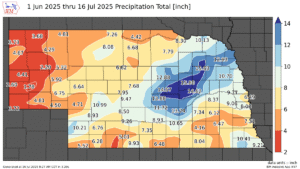
The above map is precipitation totals in inches for Nebraska from June 1 through July 16.  Note that what was once the bullseye of the drought map in May is now the deep blue for precipitation.  Since June 1, our area has received 200-300+% of normal rainfall.  All of this has been a blessing considering how desperate we needed rain this past spring.  However, there is truth in the statement….one can receive too much of a good thing…it becomes problematic to receive that much rainfall in a short time for N applications and leaching, lack of soil oxidation, and increased chances for storm damage.

  • Cooler conditions over the past month has led to slower tassel emergence and a later pollination window versus last few years.
  • Keep in mind that tassel has to be dry to shed full pollen, with peak pollen shed from 10am-2pm.  Crop canopy has stayed wet through noon for the past week and I can’t help but think that hours of peak pollen shed are anywhere near normal over last few days.  It is too early to determine how well the crop is pollinating, but early observations look good so far….
  • Post-pollination N will start to go on next week.  Considering the high rainfall amounts, you may want to think about adding an extra 20#s to your last application, especially if a heavy amount of N was applied with urea in June.  Rainfall had to move N down somewhat and the root systems are not as deep as prior years.

FUNGICIDE/DISEASES IN CORN/SOYBEANS:

  • Overall leaf disease infestations are low, other than some bacterial leaf streak.  However, we have seen our first Tar Spot lesions.  This is about 2-3 weeks ahead of 2024.  This means that this disease will get off to a faster start than last year, and environment as-of-late has been very conducive for the development of this disease.
  • Depending upon silk timing, fungicide applications should be going on now and through next week for best timing of control.  Not all fungicides are equal when it comes to Tar Spot control.  Keep this in mind when choosing which fungicide to use.  See the following link for efficacy: 2025 Corn Foliar Fungicide Efficacy Chart
  • Environmental conditions have been, and currently are, conducive for heavy disease outbreaks….highly recommended to apply a fungicide this year.
  • The same goes for soybeans.  Environmental conditions have been almost perfect for a significant white mold outbreak.  Applications for 2nd treatment should be on by August 1st.  Most bean fields will be into R3 (pod set) by that time, if not getting there already.

INSECT UPDATE:

  • So far WBC infestation levels have been low, but enough to ‘clean up’ fields….most levels at 2-6%…an odd 8-10% in spots.  Moths are still flying and will continue to do so for next 7 days in significant numbers.  Treat as soon as field is 95% tasseled.  See video:  Newly hatched WBC larvae in tassel
  • Corn rootworm levels have been higher than expected considering the low numbers seen in 2024.  We are seeing higher numbers of adult beetles, though not as heavy as some past years.  Any beetle control for potential silk-clipping should be on, or going on now.
  • So far very little insect activity in soybeans….hope it stays that way….
LUMIDERM SxS

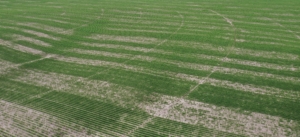
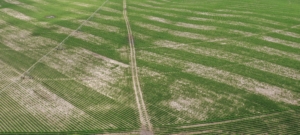
  • The above photos are from the same field.  Split planter of same soybean variety (P28Z30E) with two different seed treatments.  One side of the planter with Lumiderm insecticide and the other side without Lumiderm.  The good rows in the photos had the Lumiderm.  This field was tilled-ground and heavily pastured all winter, with late removal of the cattle this spring…sandy soil.  We saw excellent protection from the Lumiderm on seedcorn maggots, etc.
  • The past few years we have seen increased stand loss on tilled-soybeans in sandy soils from seedcorn maggots.  Lumiderm offers added protection for this pest.  We treated a lot of tilled-acres this year with Lumiderm and saw good results….though nothing as dramatic as this field!


Please mark your calendar for the Pioneer Annual Customer Appreciation Supper, set for Friday, August 22nd.  The Pioneer Plot Tour is tentatively sent for, Wednesday, September 3rd.

Please contact us with any questions or comments you may have!   Thank you for your business!!

Starman Seed & Supply, Inc.


TOPICS FOR THIS UPDATE:

  • Temperatures & GDU accumulation update
  • What’s going on in my fields right now…
  • Fungicide/Diseases in Corn,
  • Insect Update
  • Soybean Update

TEMPERATURES & GDU ACCUMULATION:

As of July 6th, we have accumulated approximately the following for Growing Degree Units in 2025:

Planting Date     GDD’s2025          Average GDD         Departure from average

April 17                  1232                           1138                                +94 (+4 days)

April 24                 1181                            1092                                +89 (+3.5 days)

May 1                     1135                            1045                                +90 (+3.5 days)

Since the last update on June 11, we have gained 3-4 days.  Instead of slightly behind normal, we are slightly ahead of normal on GDU’s.  Kind of hard to believe considering the up-and-down nature of our temps over the last few weeks.  Below maps are 6-10 day and 8-14 day temperature forecasts.


These maps need to be taken with a grain-of-salt as they change daily; however, they are predicting normal temps over the next week with a warming trend into the third week of July.  Some major ag-weather sites are saying the potential for cooler temps through the first two-to-three weeks of July is high.  This is good news as far as no stress on the crops, but will possibly delay silking dates as compared to normal….thereby increasing potential for later-maturing crops vs. last few years.  More on this in the next section….

What’s going on in my fields?

  • The corn crop in our area looks very good at present time.   Overall color is still good considering the amount of rain some areas have had over last two weeks.  Much of the corn crop is in the V12-V15 stage, which is tracking very close to normal and one leaf stage behind the 2024 growing season.   From V10-VT, corn gains a new leaf every 50 GDU’s, or about every other day.  Cooler temps will delay this to 2.5 days/new leaf.  Majority of tasseling will most likely occur from July 13-24th.  Keep in mind that hybrids silk early, or late, versus their maturity rating.  It always seems to take a little longer than expected….
  • Kernels per row began around V12 and is continuing through and up to tassel stage
  • Nitrogen needs will continue to grow through tasseling and into early reproductive stages.  Nitrogen uptake in corn is very rapid now through tassel (up to 4-8 lbs per day).  As we have discussed in the past, today’s hybrids use nitrogen later in the growing season and into the reproductive phases.  You will want to keep that last shot of N available for after tasseling….40-50#.  Keep in mind that the higher amounts of rain received in some sandy soil areas may have caused some N leaching to occur.  Keep this in mind as you determine your final N applications.  Overall color, however, looks very good throughout the area….
  • We are now into the rapid growth and accumulation of dry matter by the plant.  The window for brittle snap is still open from now to tassel….
  • Under field conditions, pollen shed usually occurs in the late morning and early evenings.
  • Pollen shed will extend for one to two weeks, but if field is uniform in plant emergence and height, pollen shed is 80% complete in 5-7 days from full tassel emergence….this will take place next week for most fields.  Expect some unevenness in tasseling/silk emergence in most fields due to the spring rains moving crop residue around and slowing emergence.
  • At tassel, vegetative development is now complete; maximum plant height and root depth is achieved.
  • VT overlaps with R1 (silking stage) when visible silks appear before the tassel is fully emerged.  By definition, growth stage R1 (Abendroth et al., 2011) for an individual ear is defined when a single silk strand is visible from the tip of the husk. An entire field is defined as being at growth stage R1 when silks are visible on at least 50 % of the plants. This whole field definition for growth stage R1 is synonymous with the term “mid-silk”.
  • A captured pollen grain takes about 24 hours to grow down the silk to the ovule for fertilization.
  • Peak pollen shed usually occurs in mid-morning.   Some research indicates that pollen shed decreases after temperatures surpass 86F.   A second “flush” of pollen often occurs in late afternoon or evening as temperatures cool.   Pollen shed may occur throughout most of the day under relatively cool, cloudy conditions….. Crop Focus – Corn Pollination Success
  • Weather conditions influence pollen shed.  If the anthers are wet, the pores will not open and pollen will not be released.   Thus, on an average summer morning following a heavy evening dew, pollen shed will not begin until the dew dries and the anther pores open.  Similarly, pollen is not shed during rainy conditions.   Cool, humid temperatures delay pollen shed, while hot, dry conditions hasten pollen shed.  We have seen more problems with pollination under cool temps vs. warm temps.
  • Generally 2-3 days are required for all silks on a single ear to be exposed and pollinated, with the silks on the butt of the ear emerging first.  The silks will grow from 1-1.5 inches each day and will continue to elongate until fertilized.  If not pollinated, silk elongation stops about 10 days after silk emergence due to senescence of the silk tissue. Unusually long silks can be a diagnostic symptom that the ear was not successfully pollinated.
  • Silk emergence and growth is dependent upon turgid pressure within the plant, in other words how much water is available in the plant to cover all of its needs.   If this is limited, (ie. dryland, low-gallon wells, etc.) silk emergence will be slowed and delayed with potential to miss the pollen shed.   Under severe water stress conditions pollen shed will still take place like normal, however, silks can be delayed, which means potential for poor pollination.
  • It takes approximately 55-60 days from silking (R1) to physiological maturity.  So if a field is silking on July 15th, it will need until September 15th to reach maturity, given average weather.  Current 6-10 and 8-14 day forecasts call for normal temps which would give us an average of 23-26 GDU’s/day.
  • High nighttime temperatures (ie. any stress) begin to play a role in final yield during grain-fill as this causes the plant to work harder to maintain both yield and overall plant health, thereby lowering potential final yield.

Corn Leaf Disease/Fungicide

  • The next four to six weeks will be critical for disease infestations and fungicide applications.  So far we are not seeing much for disease in area fields….a little bacterial leaf streak starting.  Keep in mind that if we see cool temperatures and wet conditions, potential disease outbreaks will increase exponentially.  We will also see a wider range of different diseases.
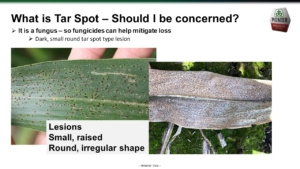
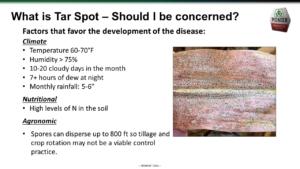
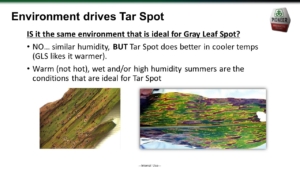
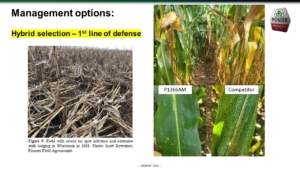
  • So far we are not seeing any Tar Spot in the area, however, it has been confirmed in Antelope county.  So, we expect that we will see some lesions moving forward.  Hybrid tolerance is first line of defense with a fungicide giving added protection.  Pioneer offers the best hybrid tolerance to this disease in the industry.  We will keep you posted on this disease if we find it….   See slides below:
  • If you are planning on only one fungicide application, the best timing for this application is after pollination, as the crop is working the hardest at this time and has the highest demand for energy.  We want to protect as much of the leaf surface as possible in this time frame, which is from pollination and the two weeks after.   Corn on corn acres are always a good place to start with fungicide applications.
  • While any hybrid can have a response to foliar fungicides, hybrids such as P05081, P05466, P0924, P09944, P0995, P1185, P1278, P13476Q, P13050, P14830, & P1563 are hybrids to focus on first for higher probability of response from foliar fungicides, especially if gray leaf spot infestations are high…..
  • 2025 Pioneer Foliar Fungicide Considerations Guide ….This attachment is a list of Pioneer hybrids and their potential response to a fungicide application for Gray Leaf Spot and Norther Corn Leaf Blight and Tar Spot. The chart also shows staygreen and stalk strength ratings for each hybrid.   This chart can help with fungicide management decisions.  Highly recommended to fungicide corn with current weather conditions….
  • See attachments on disease and fungicide management – Maximizing Foliar Fungicide in Corn
  • 2025 Fungicide Efficacy for Control of Corn Diseases.   This attachment shows efficacy and posted residuals by active ingredient.

Water Management

2025 has seen above normal rainfall over the last month…..up 130-200% over the last month and 200-300% over the past two weeks.   What a change from April/May!  This means that we have excellent soil moisture profiles heading into pollination, which is a real positive to the dryland and limited irrigation acre.

Below are some key water management tips to keep in mind:

  • The greatest yield loss from moisture stress occurs in the period two weeks prior to two weeks after pollination.  For the next two weeks, the corn crop will be at its peak water usage, with ET rates of .30+ inches per day – higher when temps are in the mid-90’s and higher yet when combined with low humidity….lower under cool and cloudy conditions.
  • ET rates over the past two weeks have been average…. .20-.25/day depending upon temperatures, etc.  However, we are reaching peak water use in corn, and with the potential higher temps forecasted out two weeks, it will be important to stay on top of overall water needs by the crop.
  • At present, we are seeing fairly good root depth according to the soil moisture probes….sandier soils are 20-32″, very similar to last year, and heavy soils are 24-36+” (slightly below average) depending upon plant date, conditions and soil type.  Remember that maximum plant height and root depth are achieved once the plant tassels.
  • Wet conditions of past few weeks has led the corn plant to be somewhat ‘lazy’ with root development, especially in the upper root structure.  Under saturated soil conditions, we expect to see some root lodged corn if a strong storm moves through the area.

Insect Update

Just beginning to see Western Bean Cutworm egg masses in sandy fields.  They are just getting flying.  Expectations are for higher pressures this growing season.

Keep these tips in mind over the next few weeks:

  • To scout for this insect, check the sandier fields first and look on the upper side of the leaf for a white, or purple, egg mass.  These will be found on the upper 1/3 of the plant.
  • We again have pheromone moth traps located west of Elgin.
  • Treat when the fields are 95% tasseled.  Use high rates (5-6oz) of a Capture-like product to give you 3-4 weeks of residual control.
  • WBC are attracted to those fields that are closest to tasseling, so this means the later planted and later silking fields have the highest potential for infestations.  Cool conditions will delay and extend their flight, so what may appear low numbers now can pickup in two weeks, which is why we recommend the extra residual.
  • Once a field has been tasseled, any egg masses that hatch will see the larvae move straight to the ear tip, so treatment soon after tasseling is critical.
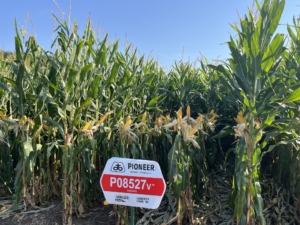
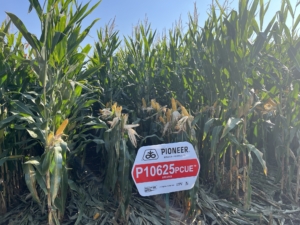
  • AML versions of Pioneer hybrids offer control of WBC/Corn earworm.  No need to treat these hybrids for WBC – these include P05081AML, P1122AML, P12904AML, P14830AML, & P2042AML and the new Enlist hybrids – P10625PCUE, P13777PCUE, & P1742PCUE.

Corn Rootworm

Adult beetle emergence will begin soon, if not already occurring….and will continue over the next few weeks.  Monitor your continuous corn acres for adult beetle populations to:

  • Prevent high numbers interfering with pollination through silk-clipping.  Males emerge first.
  • Help with rootworm control in your continuous corn acres.  Strongly recommended to use Steward insecticide (by FMC) for control of adult beetle populations to help with next year’s control of rootworm.  This product has shown excellent results for both kill and residual, which can be upwards of 30 days.  As far as timing for control, it is best to wait until there are pregnant females present.  The new Vorceed CRW technology has been shown to give 98% beetle control.  We will watch for this trend over next few weeks.
  • We are seeing some rootworm feeding from larvae in a few fields.  This may contribute to increased chances for root lodged corn under saturated soil conditions.

Grasshoppers….seeing very small grasshoppers in many sandy fields.  Numbers are low and defoliation is very minor….

Dectes Stem Borer.…Be aware that adult beetles have been emerging over the past weeks and have been migrating into area soybean fields….much as they have in the past few years….no treatment guidelines at this time….just more for you to be aware and watch as the year progresses.

Soybean Development

  • Most of the soybeans in our area are at late-R1 (Beg flower) to late-R2 (Full flower).  I would not be surprised to see early R3 (pod set) on some fields end of next week….especially in those fields planted mid-April and with early maturity varieties.  Most fields are finally coming around and growing.  No-till and later-planted fields have been slow to ‘get going’ this year.
  • Soybeans should be nodulating heavily at this stage.   At the beginning of the reproductive stage, soybeans will still put on 50% of their vegetative growth.
  • Crop water use in soybeans starts to increase rapidly at full flower, peaks at R3 and will stay high through R6, or full seed  Flower stage is usually the time when the soybean plant begins to pull from the deeper root zones….we see this happening on the soil moisture probes in the area.  Heavy soil moisture profiles are full enough that very limited irrigation will be needed on soybeans through July, unless temps turn off hot.  Sandy soils will need monitoring as area rains have been spotty ove the past week or so and they may need a shot of irrigation to keep growth moving.
  • We continue to see a yield response from a fungicide application in soybeans, either at R1/R2 for white mold (applications of which should be on, or going on, the first planted, and going on this week for later planted acres) and/or a later R3 (pod set) stage of growth.  Environmental conditions over the next two months will determine disease incidence and overall level of disease infestation….and so far, we have had weather conditions conducive for higher outbreaks of disease, both soybeans and corn.  Just a reminder, keep an eye out for Frogeye Leaf Spot  in soybeans as not all fungicides control this disease.  This disease is normally not an issue in our area and many varieties have very good tolerance to this disease.  See attachment for more info on this disease….Frogeye Leaf Spot in Soybeans
  • Recent weather conditions have increased the potential for White Mold.   If current weather trends continue into August, expect White Mold outbreak to be as high as two years ago.  For White mold management see attachment:  Managing White Mold in Soybeans  Highly recommended to apply a fungicide for white mold to most acres.  Apply Viatude, Aproach, or Delaro for best control…really, only control….for white mold….2025 Soybean Foliar Fungicide Efficacy Chart

Thank you for your business!!   Please let us know any questions or concerns you may have!!

Starman Seed & Supply, Inc.


TOPICS FOR THIS UPDATE:

  • Planting and Early Spring conditions….
  • Temperatures & GDU accumulation
  • What’s going on in my fields right now…
  • Insect Update
  • Soybean Update

PLANTING AND EARLY SPRING CONDITIONS:

  • 2025 planting got off to a fast start with both corn and soybean planting much ahead of normal.  By May 1, 75%+ of soybeans were in the ground, and by May 5th, 90%+ of corn was planted.
  • This was due to above normal temps and dry conditions through much of April and 1st half of May allowing for no stoppage due to moisture.
  • Temperatures for April and 1st half of May averaged 2-3 degrees above normal leading to quicker emergence and what appeared to be rapid growth heading into June…
  • However, temperatures for last three weeks have been 2-4 degrees below average, causing slow emergence on last soybeans planted and slowed down growth….
  • There were a lot of windy days in May as well, which slowed up growth and gave much of the corn crop a ‘beat up’ look for a few weeks.  We are seeing more unevenness now in height and color from the winds, cool temps and wetter conditions…..
  • Overall stands for corn have been very good and soybean stands are the best they’ve been in last few years, especially on the tilled soils.

TEMPERATURES & GDU ACCUMULATION:

As of June 10th, we have accumulated approximately the following for Growing Degree Units in 2025:

Planting Date     GDD’s2025          Average GDD         Departure from average

April 17                  599                            608                                – 8 (-.5 day)

April 24                 548                            570                                 -14 (-1 day)

May 1                     502                            506                                 -13 (-1 day)

We were +4-5 days ahead of average for April and 1st half of May, but the cooler temps of last few weeks have caused the crop to lose that ground, to where we are now just even.  We are slightly ahead of last year yet, however.  The heat that has returned this week and forecasted to last through next week will help us to gain a little ground.

PRECIPITATION


We all know how dry it was in April and through most of planting.  The recent rains have been a godsend as we were getting beyond desperate for moisture.  The above map will help put things in perspective so far.  The above maps show percent of normal precipitation for April, May and the last two weeks.  This is why it was so important to run those pivots at planting and after as this really helped achieve good and uniform stands.  While we did get some good relief over the past few weeks, we could easily fall into severe drought conditions if rainfall turns below normal over next couple of months.

WHAT’S GOING ON IN MY FIELDS RIGHT NOW?...

As mentioned above, overall corn stands are very good.   The majority of the corn crop is in the 5-7 leaf stage.  From V1-V10, corn gains a leaf collar about every 83 GDU’s…this will be about every 3.5 days with current forecasted conditions.   This would put us in the mid-July time frame for tasseling….

  • At V5, leaf and ear shoot initiation will be complete and a microscopically small tassel is initiated in the stem apex tip, or top of the growing point.
  • At V6, the growing point and tassel will be above the soil surface and the stalk is beginning a period of greatly increased elongation.
  • Determination of potential kernel rows around will be completed around V7 (range of V5-V8)…all fields are now is this stage….
  • The corn root system is now rapidly transitioning to the main nodal root system.  When hot temperatures occur following a cool spell, crop growth at this stage can be uneven.  Areas of heavier residue will start to look shorter.  It will take a little time for that to catch up.  We are experiencing this right now.
  • At V9, an ear shoot will develop from every above-ground node, except the las six to eight nodes below the tassel.  Growth of most of the lower stalk ear shoots eventually slows, and only the upper one or two ear shoots will develop into a harvestable ear.
  • At V10, the time between the appearance of new leaf stages will shorten….generally every 2-3 days.
  • We are now heading into the rapid growth and accumulation of dry matter by the plant.  The window for brittle snap will start to grow exponentially over the next few weeks.
  • Pre-emerge herbicide control has been very good in both corn and soybeans considering the early, dry conditions.  Rainfall received over last few weeks has really helped here.  Palmer is really starting to come over last couple of days, so be scouting now for any potential respray as the window for application in corn will close quickly this week for the April planting dates.
  • Watch temperatures as you are spraying post-herbicides on corn or beans.  When temps are in the 90’s and humidity is very low, (or very high), the potential for crop response from post-application of herbicides will increase.  It is not recommended to be spraying during the heat of the day if temps are in the low-to-upper 90’s…both for potential crop response and herbicide control.  Contact only herbicides like Liberty need full sun, warm temps and high humidity for good control.

INSECT UPDATE:

Corn Rootworms

It’s about that time to start seeing our annual rootworm hatch. When we see the cotton start to fly, or the famous lightning bugs, we will know rootworm hatch is underway because it takes about the same GDU’s (680-750 soil based degree days) for all of these things to happen….cotton has been flying for awhile now….

Some CRW facts:

  • Larvae in sandy soils can become scratched and lacerated causing more mortality
  • Flooded or saturated soils will cause more mortality, we had a lot of this last spring which did lead to below normal adult beetle emergence last summer.  This should lead to lower CRW infestations for this year.
  • CRW will go through 3 growth stages (Each last 7-10 days)
  • 3rd Instar will create the most damage to corn roots
  • Begin scouting continuous corn acres now through the rest of the month of June.

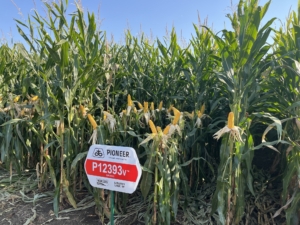
There are many management practices that can help mitigate the risk of yield loss or lodging due to corn rootworm. The best recommended strategy is to rotate to soybeans.  Overall pressure was much less in 2024, so hopefully, overall larvae populations are starting from low numbers.  The new Vorceed Enlist technology from Pioneer is a new ‘tool’ in the toolbox for CRW control.    Vorceed offers three distinct modes of action for protection against CRW, with 98% reduction of adult beetle emergence.  If you planted a hybrid with a number that ended with a V (ie. P13777V example), that hybrid has the Vorceed technology.

Corn Rootworm Scouting and Management

European Corn Borer:

  • We have yet to see ECB moth flight begin. However, we should start seeing moth’s flying over the next two weeks with egg-laying starting next week of June and lasting through June.  For those of you who have conventional white or yellow corn and/or popcorn, begin scouting for this pest the week end of next week and scout over next few weeks.  We will keep everyone updated on this pest….
  • On premium priced acres, treat at 5-10% infestations.

Wheat Stem Maggot in Corn

  • We have had a couple of fields with this pest causing some weird growth and/or reducing stands.
  • Rare pest, but possible when corn follows rye cover.
  • Maggots feed in green stems of rye – when rye crop dies, they move into emerging corn.
  • Symptoms in Corn:
    • Dead center whorls
    • Stunted growth
    • Excessive tillering
  • Timing: highest risk when cover is terminated after corn is planted.  It is possible that early GDU accumulation may have ‘pushed’ the insect into being able to cause damage before the rye cover was terminated.  May want to consider applying an insecticide when terminating the crop….but very rare pest….very rare….
  • No rescue options.

SOYBEAN UPDATE:

  • As mentioned above, vast majority of soybeans were in the ground by May 1st which is the most ever by that date.
  • For the most part, soybean stands are better than prior years, especially on the tilled acres.  The early planted beans have better stands than those planted later in May when soil conditions were drier and temperatures cooled down.
  • Many no-tilled fields have the ‘usual’ look to them of uneven growth and color.  Much of this is due to soil structure conditions at planting and after….worse in the heavier residue, again very typical for no-till.  This year the tilled fields look better than the no-till, which was not the case last year.
  • Nexta Shield for soybeans – NEXTA Shield is a product in Pioneer’s lineup of Biologicals.  Shield is a product that mixture of growth hormones that promote plant growth under stress conditions.  This product can be tank-mixed with your post-application of herbicide.  This is a product that can help with uneven growth and heavy residue fields.
  • The early planted beans are reaching the stage where it will be time for a post-application of Enlist or Enlist/Liberty.
  • Maximizing Enlist Applications
    • Nozzles – TeeJet AIXR or AI-TTJ
    • Pressure – run in the high end of your nozzle’s pressure range
    • GPA – 20 GPA minimum with Enlist/Liberty
    • Enlist can be sprayed through R1 soybeans
    • Liberty Timing Tips:
      • Spray after dew is gone
      • Stop 2 hours before sunset
      • Ideal conditions are 70-85F, sunny and higher humidity.
  • No insect concerns in soybeans at present time.

Impact of Weed Height

Something to share that could easily get overlook is how much faster weeds grow per day in June than in April.   As you know well, Palmer amaranth grows rapidly; much faster in June than April

  • So how does the performance of Enlist One® herbicide + Liberty change with increasing weed height?
    • Multi-state study funded by Corteva & BASF – Enlist One 2 pt + Liberty 32 oz
      • 3-4” Palmer amaranth verses 6-8”
        • 90% vs. 78%
      • 3-4” Waterhemp verses 6-8”
        • 98% vs. 82%

Influence of Temperature

Most research suggests weeds are best controlled when air temperatures are between 75-86F

So what happens when air temperatures are colder or hotter than ideal?

  • Glufosinate performance declines under colder night/day temperatures

Please reach out to us with any questions or concerns you may have over the next few weeks.  Stay safe!   Thank you for all of your support!!

STARMAN SEED & SUPPLY, INC.


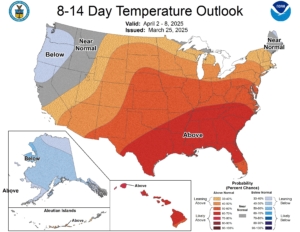
With the 2025 planting season fast approaching, we wanted to give a quick update as we begin thinking about planting.  As is the case every year, keep in mind that planting conditions will be different than what we experienced last year.  Soil temps will warm up quickly, much as they did last year, if the longer range forecasts hold true (see weather outlook below for more info).  However, current soil moisture conditions heading into planting are on the dry side versus last couple of years (though rain is forecasted next week).  Because of the lack of moisture and snow cover this past winter leading to lack of breakdown of crop residue, expectations are that crop residue will be more of concern for planting than last couple of years….more like what was seen in 2022 (May derecho year).

  • Early Spring conditions and weather outlook…
  • Cold soils and Corn/Soybean Emergence & Disease…
  • Things to Keep in Mind when Planting Early…
  • Plant First & Hybrid Stress Emergence Ratings…

EARLY SPRING CONDITIONS & WEATHER OUTLOOK


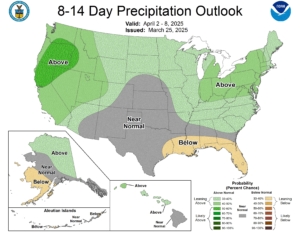
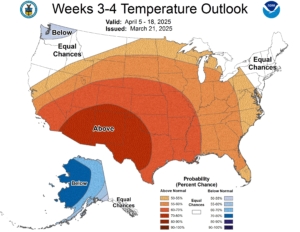
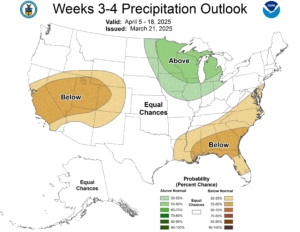
While these maps must be taken with a ‘grain-of-salt’, they do give us a general trend outlook.  Note that soil temps will warm up quickly if the 8-14 day and 3-4 week forecasts hold true.  Moisture is forecasted over next 7-10 days, but outlook appears to be more normal amounts than above-normal amounts.  See link below for total moisture amounts over next 10 days.

Total Precipitation Forecast through Apr 4

Besides having equipment ready to go before planting, 2025 looks to be a year where it will be important to make sure your pivots are ready-to-run before planting begins.  As was mentioned at the March Crop Shop, if dry conditions persist through April into May, the pivot will be a critical management tool for achieving uniform stands and improving weed control.

COLD SOILS AND CORN & SOYBEAN EMERGENCE

Optimal soil temperatures for planting corn is 50 degrees and above.   Imbibition of cold water can lower germination rates and cold soil temperatures can delay emergence allowing for more diseases to set into the seedling.  If temperatures go as predicted above, we have a good chance for rapid soil temperature improvement, however, it will still take 4-5 days of such temperatures to reach minimal planting temperatures, especially on a consistent basis, so one will want to allow for a couple of warm days before dropping planter in the ground (as always, what the nighttime temperatures will be is the key thing here).  Here is a quick look at how a seed germinates.  Imbibition of soil water happens within the first 48 hours and is why it is critical to plant when soil conditions and soil temperatures are right.  Main point to keep in mind, is that the best time to plant is heading into a 2-4 day warm temperature period right after planting.  Most reduced stands occur when planting into a cold spell, or before giving the soil temperatures time to warm up some right after a cold period.  See link below for more info.

Soil Temperature and Cold Emergence

Because we always have variable temperatures during planting season, we recommend increasing soybean (by 10k/a) and corn (by 1-2k/a, unless already dropping 34-35k) populations when planting early.  We tend to plant soybeans when it seems to cold for corn, but soybeans are really not any better out-of-the-ground than corn….just less risk involved versus corn.  Keep in mind also, that the amount of crop residue will play a role here, besides temps.

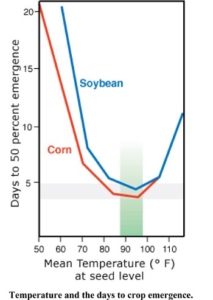
DAYS TO EMERGENCE: SOYBEAN AND CORN

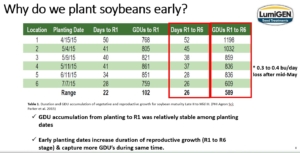
This graph helps explain days to emergence that it takes for both corn and soybeans when soil temps are at different levels. When soil temps are at 50-55 degrees it could take 3 weeks to see emergence. The next graph shows why we recommend planting soybeans early – it’s to maximize our flowering and poding days to allow for more time (days) for pods to set.


SOYBEAN/CORN EMERGENCE PROCESS:

Soybean Emergence:

Imbibitional Phase:

  • Happens less than 24 hours; typically 8-12 hours. After imbibitional phase ends, the risk of chilling injury also ends.

Osmotic Phase:

  • A much slower uptake of water occurs. Seedlings can be more tolerant to soil temps as low as 35-40 degrees. Will increase days of emergence and increase risk of soil borne pathogens if soil is cool.

Corn Emergence:

Wait to plant until soil is at 50-55 degrees

  • Kernel moisture = 10-12% @ planting
  • Imbibition of soil water
  • Kernel moisture = 30%
  • Soil at 50-55oF
  • Enzymes:  starch -> sugar

Typically 80 GDU’s: radicle emergence

Typically 130 GDU’s: plant emergence

THINGS TO KEEP IN MIND WHEN PLANTING EARLY

  • Fluctuating soil temperatures can cause imbibitional seed chilling, erratic emergence and cold temperature injury
  • Average last freeze date:  3rd-4th week in April for Central Nebraska…
  • Seed Soil Contact is key to fast emergence and stand establishment…..soils that are too wet can lead to side wall compaction, crusting and poor seed to soil contact.  In dry conditions, it gets more difficult to get good seed/soil contact as air pockets are increased due to loose and crumbly soil structure, which is why having pivots ready-to-run is key here.
  • Herbicide injury can occur more often in cool, wet soils where the plant isn’t growing at an optimal pace.
  • Planting Depth….Optimum planting depth for corn is 1 1/2 to 2″, with 2″ best under normal conditions as this is best for optimal nodal root development.  Soil temperature fluctuates more in the top 1” = one reason why we plant at 1 1/2  to 2″ deep.   Never plant shallower than 1 1/2″ and we see no reason to go deeper than 2 1/2″.   Always err on the deeper side vs. the shallow side for depth.  More bushels are lost from too shallow than too deep planting.   Optimum soybean planting for soybeans is 1-2″…err on the deeper side under cold conditions.  If soil conditions stay dry, expect soil conditions to be harder than normal and seedbed will be ‘crumbly’ with high amount of air pockets, impacting planting depth and reducing seed-soil contact.
  • Plant populations….Consider increasing population drop under heavy residue and cooler conditions.  This is especially so for soybeans….if planting in April consider bumping up soybean seed drop by 10% to offset adverse weather conditions….even more needed if planting in April and have a tilled seedbed.  Most of the time any replant discussions would’ve been eliminated had seed drop been bumped up at planting.  Seed corn maggots have been an issue the last few years on tilled, sandy soils when planting in April.  In these situations, it is recommended to use Lumiderm insecticide seed treatment for increased protection from seed corn maggots.  See link below for suggested plant populations by hybrid and hybrid x environment interactions for northeast Nebraska from Pioneer.

2025 Pioneer Planting Rate Suggestions & Hybrid x Enivronment

  • Soybean planting date:   UNL research shows that you can lose up to ½ bu of yield potential per day after May 1st. Just remember, the earlier you can plant you maximize the days of flowering and pod set to give you more time for re-flowering and setting more pods. (Refer to picture referenced earlier in this update)
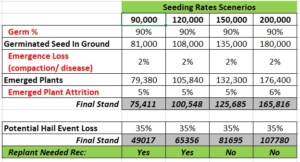
  • Soybean seeding rate: we recommend 140,000-160,000 seeding rates. This seems to give us a good compromise between seed cost and potential loss from storms or other unforeseen events. Here are a few scenarios to consider when looking at seeding rates:


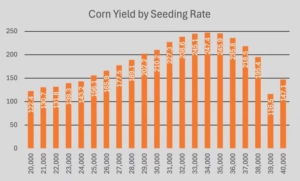
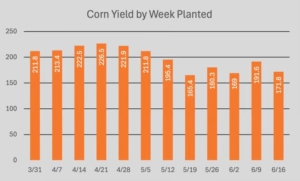
The above graphs show Corn Yield by Seeding Rate and Corn Yield by Week Planted for Nebraska using Granular Insights data from Pioneer Hi-bred.  The data shows what we have seeing in our geographic area as well.

See link below for more planting information, tips, and resources from Pioneer:  2025 Pioneer Planting Guide and Resources

PLANT FIRST RECOMMENDATIONS

One of the most frequently asked question is “What product should I plant first?”  With the cooler soil temperatures normally experienced at the beginning of planting, we believe that it is important to start with a hybrid that shows strong emergence and early vigor.  The below bullet points show our recommendations for “plant first” products if soil temps are cool. The hybrids are listed by maturity not by how well they emerge.  These are products that have shown to have strong emergence and early vigor over the past several seasons.  Selecting one of these hybrids to start with can help provide the best chance for optimum emergence when soil temperatures are cooler at the start of planting.   However, considering how fast our soils can warm up, and if one is planting into a warm stretch, we don’t have an issue with starting with most any hybrid…key is the first 48-72 hours after planting.  Keep in mind the 2-5 day forecast ahead of anytime you are planting.  Remember also, that we will continue to experience soil temperature fluctuations as we go through planting….whether planting in April or May….keeping right product, for right acre is just as important.

  • 105-109 CRM – P0487, P05466*, P0622*, P0859, ,P09944*, P0924
  • 110-118 CRM – P1164*, P1122, P1170, P13050*, P13476Q*, P13777, P1413, P1563, 17677
  • * – very strong emergence….

CORN AND SOYBEAN EARLY SEASON DISEASE REMINDER & LumiGEN Seed treatment:

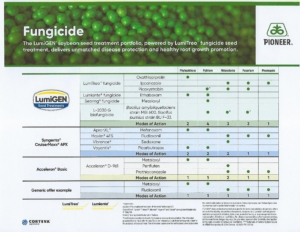
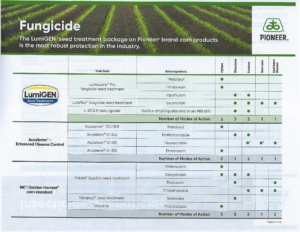
 Early planting, cool and possibly wet soils, all come with the increased risk of early season diseases.  Keep in mind that Pioneer has the industry-leading seed treatments on corn and soybeans.  No company has more active ingredients.   A new addition to the LumiGen soybean seed treatment for 2025 is Lumiante fungicide.  This product adds Ethaboxam fungicide to the mix for greatly improved Pythium control.  Pioneer has added Ethaboxam to corn for the past number of years now and it was a ‘game-changer’ when it first came out.  Our expectations are to see this in soybeans as well.  No seed company in the industry offers the number of MOA’s that Pioneer does.  We have seen the difference vs. competitor over the past few years!

2025 LumiGEN Soybean Treatment offering                                      2025  LumiGen Corn Seed Treatment


Please contact us with any questions or comments you may have.  Thank you for your business!!

Have a safe planting season!!

Starman Seed & Supply, Inc.
                       

NEXTA >>      Start, Grow, Finish….

Introducing NEXTA Biologicals from Pioneer….Start, Grow, Finish….

NEXTA Biologicals are for both corn and soybean crops.  Click on link for more info.

Nexta Product Brochure

Video below is Nexta Performance Update from 10/18/24.  Click on the white space below to start video.


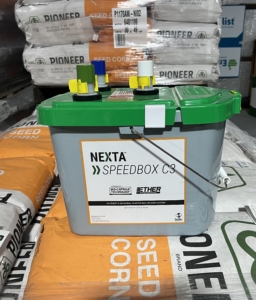
Introducing NEXTA Speedbox…….NUTRIENT & MICROBIAL PLANTER BOX DELIVERY SYSTEM FOR CORN.

This is a ready-to-use planter box treatment with 80/20 talc/graphite and micronutrient blend, with a high-volume load of zinc….plus 3 products of a biostimulant, microbial bacteria, and enzyme.  Click on link below for more info.

Nexta Speedbox_Brochure


TEMPERATURES & GDU ACCUMULATION:

As of September 26th, we have accumulated approximately the following for Growing Degree Units in 2024:

Planting Date     GDD’s2024          Average GDD                 Departure from average

April 23                   2777                         2680                                +97 (+6.5 days)

May 4                      2694                          2602                               + 92  (+6 days)

May 14                    2597                          2506                                +91 (+6 days)

As one can see from the above table, we are FINALLY above normal for GDUs’.  Last year at this time, we had 2858 using April 23rd planting date.  Other than lack of rainfall, the month of September has been good for finishing the crop.  So far, September has been the 30th hottest in the last 132 years.  For the most part, we also had abundant sunshine in September.  This really helped kernel depth and test weights.

  • Overall staygreen has been better than expected, with some fields still holding on to their color.  However, those fields that had high levels of Southern Rust and/or Tar Spot are now quickly losing color and should be on the list for early harvest.  Crown Rot is still prevalent in many fields, so continue to watch those fields that dropped ears quickly, or ‘turned overnight’, so to speak….
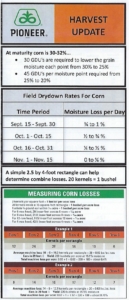
  • High moisture corn, if planning on using fields planted in April, should be coming out now, as moistures are dryer than one thinks…due to the warm, dry, low humidity September.  Seeing dryland fields coming out at 14-20% moistures.  Early test weights have been good….see photo for corn harvest drydown and measuring corn loss….
  •                                                        
  • No trends for irrigated corn yields yet, but so far, early yields on dryland, heavy soils have been very good!
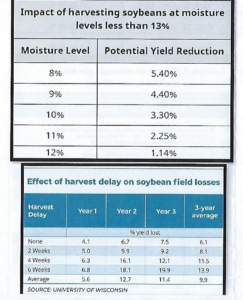
  • Soybean dryland yields have also been better than expected, considering no rain since July 1st for much of our area.  In those areas that received more rain, dryland yields are excellent.  Early irrigated yields are average to above average, but still to early for a trend….mostly early group II beans coming out yet, with some early planted 2.5’s starting to come out….see photo for soybean moisture impact on yield and effect of harvest delay on soybean yield losses.

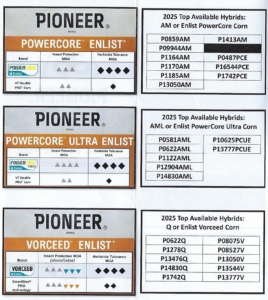
POWERCORE ENLIST & VORCEED ENLIST

Photo shows the Insect Protection Modes of Action and Herbicide Tolerance Modes of Action for the new Powercore and Vorceed technology, along with the top available hybrids (new and current) for 2025.

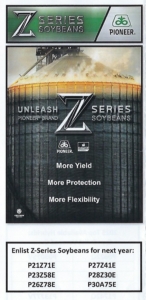
Z-Series Soybeans

Photo shows the advantages of planting Z-Series soybeans from Pioneer, as well as the top varieties for 2025 in Z-series.  Early performance on the Z-Series has been very good!

It’s fun and rewarding to see one’s hard work over the past year come to fruition at harvest time; however, please remember that the most important thing is to be around to take advantage of that hard work.  Please stay safe out there!  Have a safe and successful harvest!

Starman Seed & Supply, Inc.


Topics:

  • GDU/Weather Update
  • Corn – Soybean condition & Early Harvest trends…

TEMPERATURES & GDU ACCUMULATION:

As of September 18th, we have accumulated approximately the following for Growing Degree Units in 2024:

Planting Date     GDD’s2024          Average GDD     Departure from average

April 23                   2641                          2590                                +51 (+3 days)

May 4                      2558                          2500                               + 59  (+3.5 days)

May 14                    2462                          2410                                +52 (+3 days)

Corn – Soybean Conditions…

  • From the above numbers, we see that GDU accumulation has picked up over the last week or so as compared to the last update.  We are at now reaching GDU numbers that get us close to black layer.  The early maturity hybrids planted in April are at basically at black layer, which is matching the GDU numbers above.  The fuller season hybrids planted in April are now 3/4 milk and should reach black layer next week.  The mid-May planting dates are needing more time…still looking at needing till October 1 or so to reach close to black layer for full kernel depth and good test weights.  Hybrids will adjust their maturity to later planting dates, meaning they often will mature using less GDU totals than rated.  However, this can mean less kernel depth and test weights as compared to normal; especially in years like this one, where GDU accumulation has always been ‘behind’….any extra stress during a year like that, has the potential to compound the issue.  Temperatures for September have been above normal.  This has ‘pushed’ the crops along, but was much needed.  Current long-term forecasts continue to predict normal to above-normal temps through October and dryer conditions….
  • Corn staygreen heading into harvest will not be as good as last few years.  2024 has had too many stress events starting with planting conditions/heavy rainfall, periods of cool temps followed by heat, lack of rainfall during grain fill, to name a few.  This has put more stress on the plant, reducing leaf area for photosynthesis, causing the plant to ‘work harder’ than normal to maintain yield.
  • However, overall color has held up better than we anticipated, considering the heat/dry conditions of the past two weeks.  Continue to monitor staygreen over next few weeks.  Monitor those fields that lose color the quickest over next few weeks as they will be the first ones to go after for harvest.  Due to the increased stress the crop experienced this year, we still expect stalk quality to be poor come mid-to-late October….
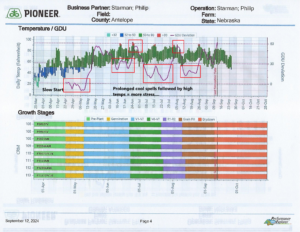
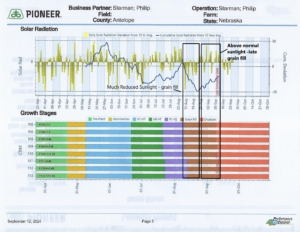
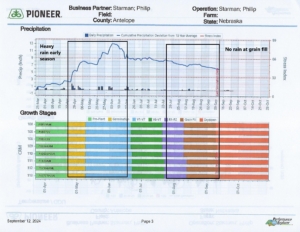
  • See graphs below: 
  • Note in the first graph, the cold period during planting, and then the numerous prolonged cool spells followed by heat spells, that occurred throughout the summer.  Our area experienced the 30th coldest July/August out of the past 132 years.  Early cold/wet conditions slowed growth and impacted early root development, while the ‘ups-and-downs’ during the summer had the ‘plant engine’ running a little off.
  • In the graph on sunlight, note the lack of sun during early grain fill, this can cause ear tip-back and puts stress on the plant by reducing energy production that is needed during peak energy needs.  Thankfully, this has been followed by above normal sunlight, helping us ‘finish’ the crop in better shape than anticipated.
  • The last graph shows precipitation.  Note the high rainfall in May and June and the steady decline during grain fill.   Thank goodness we received the early rains considering how dry grain fill has been.  NE Nebraska saw the 16th driest July-Sep for precipitation in the last 132 years.  This added stress to the crop as well, and is the reason we have ‘turned’ earlier than anticipated as well, especially soybeans over the past month.
  • All of the above has lead to an increase in Fusarium Crown Rot as we continue to see more ears begin to drop and an increase in ‘ghost plants’ as the weeks progress.  Tar Spot has increased over last week as well, while southern rust is just a ‘slow burn’.
  • There is some very good corn in area irrigated fields, as kernel depth and color looks good as we move into the later half of September.  We still expect to see more variability in irrigated yields this year versus past few years from the growing season we had.  One of the biggest yield-limiting factors this year will still come from the early/heavy rains we received and the washed out areas/rows and drowned out spots that are in most every field.  Second potential on yield will be ‘can we get it our before it wants to fall apart?’  There will be more standability issues this year than we have seen over the past number of years.
  • Very early dryland corn/soybean yields seem to be good, much better than anticipated considering the dry July/Aug/Sep we had.
  • Grain moisture drydown is dependent upon temperature and ear husk structure.  Starting to see husks begin to open in fields now.  On average, it takes 15-20 GDU’s to lower grain moisture each point from 30% down to 25%, 20-25 GDU’s per point of moisture from 25% to 22% and 25-30 GDU’s per point from 22% to 20%.  A high of 75 degrees and a low of 55 degrees equate to 15 GDU’s, which should roughly take a point of moisture out per day when grain moisture’s are 25%+.  So temps in the mid-70’s for highs and mid-50’s for lows should take corn from 30% to 25% in a week’s time.  Forecasted temperatures for this weekend and through next week, will limit grain drydown, as we will accumulate only 10-15 GDU’s/day with the temps forecasted.
  • Silage yields have been trending normal overall…hearing a lot of upper-20’s to mid-30’sT/A for tonnage.
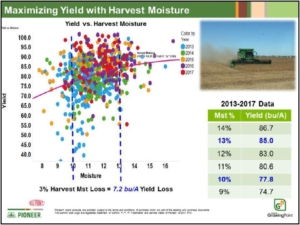
  • Soybean harvest moisture: There is an average yield reduction of 7-8% when going from 13% moisture to 8% moisture soybeans.  This means an average loss of 6 bushels/acre (using an 80 bu yield) just in moisture, along with potential reduction from header loss, etc.   The below chart shows the average yield lost from lower harvest moisture and delayed harvest over five year on-farm study from Pioneer.
All for now.  As harvest progresses, we will text out plot info and updates.  Have a safe and successful harvest!!

Starman Seed & Supply, Inc.

Topics:

  • Growing Degree Unit Update/Weather Forecast
  • Corn/Soybean Update
  • Prioritizing Harvest….
  • New Corn Hybrids and Soybean Series for 2025…

TEMPERATURES & GDU ACCUMULATION:

As of September 9th, we have accumulated approximately the following for Growing Degree Units in 2024:

Planting Date     GDD’s2024          Average GDD     Departure from average

April 23                   2464                          2471                                -7 (even)

May 4                      2381                          2378                                + 3  (even)

May 14                    2294                           2297                                -3 (even)

From the above numbers, we have gained since the last update on August 25th, when we were 3-4 days behind average.  However, we continue to struggle to get a consistent period of heat.  This past weekend -while beautiful weather – we only accumulated 11 GDU’s/day.  This just doesn’t help us to gain a lot of ground.  On the other hand, the crop has continued to move along and the forecast for the next 10 days will help this out.  We should accumulate 20+/day, which is above average for this time of year.  For comparison, at this same time last year, we had accumulated 2630 GDU’s by September 9th with April 23rd planting date….this puts us a good 8-9 days behind last year…this difference is the same across all of 2024’s planting dates used above.

Current Corn Conditions…..

  • Much of the corn crop is as follows:  April planting dates – 105-110 day hybrids 2/3-3/4 milk lines and 112-118 day 1/3 to 1/2.   Later planting dates are 1/8 to 1/3 for the most part.  Most fields will take another 10 days (April planting dates) to 30 days (mid-May planting dates) to finish, using average-to-above average temperature forecasts over this time period.  The current 10 day forecast looks conducive for development, so let’s hope it stays that way, as we need it.  Silage harvest is happening sooner than expected, which is a positive to further crop development.  The heat spell coming up will impact the crop in other areas, as it will move quicker than we have experienced as of late, more on this below….
  • Sunlight:  Solar radiation for September has been above average by 10%, which has been a positive to kernel development and hopefully plant health.  On the flip side, sunlight for the month of August was 3% below normal.  Most of the sunlight that was received in August was received in the last two weeks.  The first two weeks were below average by 5-8% which was during early-mid grain fill.  This would have a possible negative impact on stalk integrity later into harvest due to reduced photosynthesis.  Sunlight plays a key role in kernel depth and test weight, as well as overall plant health.  Again, September sunlight has been very good, and is forecasted to stay that way.
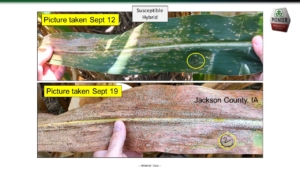
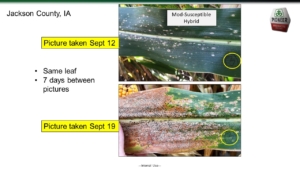
  • Disease:  If there is one big difference in this year over the past 5-8 years, it is in leaf disease.  Corn fields in the area have never been this ‘marked up’ with leaf disease for quite sometime.  Even fields with fungicide are showing more lesions overall, however, they are still reduced versus fields that had no fungicide applied.  The biggest driver of disease right now is Southern Rust.  This year has seen the biggest outbreak of this disease since 2006.  Most all area fields have this disease present, but the severity is not the same everywhere…and overall levels are not as high as was seen in 2006; however, there are some fields which are as bad as 2006.  This disease really ‘blew up’ the last week of August, but has slowed down some with the cooler weekend.  We are expecting it to increase in severity with the heat that is coming in this week.  This disease does not overwinter here, so it is not usually a concern, however, if we get a lot of southerly winds, and/or hurricane outflow (think hurricane Beryl in early July), we have a greater chance for this disease to develop.   See link for more info: Southern Rust in Corn              Tar Spot has been confirmed by leaf sample in our area.  Confirmation was 13 miles west of Elgin on a 113 day competitor hybrid.  With it being confirmed west of Elgin, this means that the disease is throughout our area now….and we have been finding it in most fields in the area this week.  This disease is a fast mover….see photos….113 Competitor hybrid.
  •    
  • First photo is from August 15th, first lesions.  Second photo is two weeks later, August 29th and third photo is another week later, September 4th.  This disease bears watching in the years ahead.  This is on a hailed field, so progression is faster than normal.
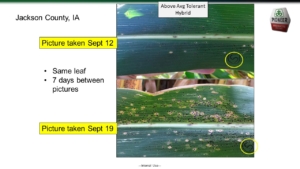
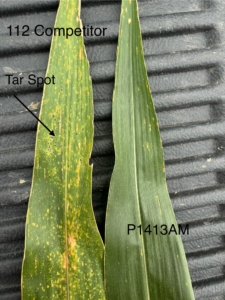
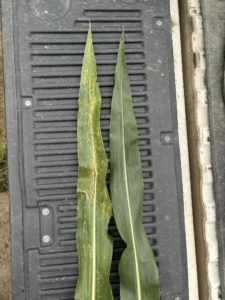
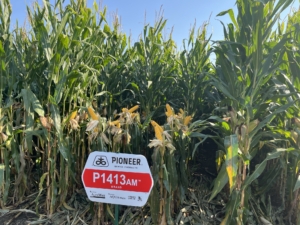
  • This second set of photos is a comparison of a split planter of P1413AM vs. 112 day competitor, on tar spot and southern rust levels.  Photos taken September 10th.  This set of photos is from a field that had a fungicide applied.
  •      
  • For Tar Spot, Pioneer offers some of the leading tolerance, across the hybrid lineup, within the seed industry.  Besides the irrigated acre, keep this in mind for the dryland and more marginal acres, that do not see a fungicide every year…
  • Due to the higher incidence of disease pressure in 2024, we expect to see an impact on area corn acres this year, most likely in late-season plant health.  See Prioritizing Harvest below for more info.
  • Because of the delayed growing season, it is somewhat early to determine overall grain quality heading into harvest.  Test weights are still being determined over the next couple of weeks.
  • Irrigation demand is slowing down and we can see the end, but is still needed in many cases.  Keep in mind that 1/2 milk line corn requires 2.5″ – 3″ to finish, more in hot weather.  ET rates will approach .30-.40+ over next few days if humidity stays low and winds increase.   Keep this in mind over the next 5-7 days.  Don’t shutoff to early….the longer it stays green, the better yield and plant health. 

Current Soybean Conditions…..

  • Soybeans are starting to turn in much of the area.  Most fields are in mid-R6 to early R7.  The early group II soybeans are moving along quickly now.  A few mid-April planting dates with 2.0 maturity could be ready to harvest by next week, if heat comes as forecasted.
  • Disease:  Sudden Death Syndrome (SDS) is present in the area, but not at the levels it was seen last year.  The same can be said for White Mold infestations.  White Mold has been light, compared to last year.  Disease pressure in soybeans has been much reduced this year compared to prior few years.
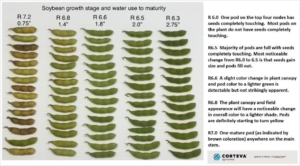
  • Irrigation: Fields in the late-R6 to early-R7 stage need approximately 1.5-3″ of moisture to finish.  For reference, the chart below shows soybean stage of growth at R6-R7.  Don’t give up on that last watering…..
  • Dectes Stem Borer.  This insect enters the plant at a node and proceeds to ‘hollow out’ the stem leading to early plant death.   So far not much one can do in the way of management for this insect yet.  However, we are expecting to see heavier levels of this insect in our area versus the past few years.   Keep this in mind as harvest begins and progresses.   For more info see the following link….Dectes Stem Borer in Soybeans

Prioritizing Harvest!

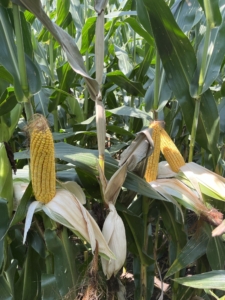
The extremes in weather (early planting conditions/rainfall, cool summer with intermittent heat spells, reduced sunlight during grain fill, increased disease pressure, drought conditions) in 2024 have the potential to impact late-season stalk quality.  Southern Rust will have the biggest impact on stalk quality, which was the case in 2006.  Heavy fields of Southern Rust will be very likely to have poor late-season stalk quality.  We are also seeing Crown Rot show up in area fields.  Infestation is variable across the area, but it is noticeable.  See photo for ‘ghost stalk’…..

Stalk rots appear each year with varying degrees of severity. They are caused primarily by fungi and bacteria, but they can also result from environmental stresses. When these diseases or conditions happen, they weaken or destroy vascular tissue in the stalk, and the plant cannot transport water or carbohydrates effectively, which ultimately results in premature plant death and reduced grain fill.  The environmental stresses this year are putting more pressure on plant health.  Watch for those fields that lose staygreen quickly, or that have ears droop suddenly, as these are signs of premature plant death.  The longer the plant stays green, the better the standability will be as harvest progresses.  Bottom line….we are expecting 2024 harvest to have significantly more issues with stalk integrity as harvest progresses.  This is one year where you want to be ready ‘to go’ at the first opportunity….equipment, labor, etc.

New Corn Hybrids and Soybean Series


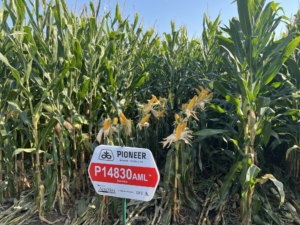
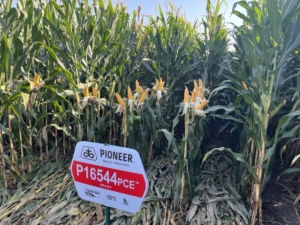
The above photos are some of the new hybrids for 2025 with a couple of the leader products from the show plot.  For 2025, Pioneer has over seven new corn hybrids across the 105-116 day maturities.  The photos above show some of these new products.  For 2025, Pioneer is also introducing new Powercore Enlist, Powercore Ultra Enlist and Vorceed Enlist technology in corn. All new hybrids from Pioneer in 2025 will have the Enlist technology, with Powercore providing above ground protection like the current AM products, Powercore Ultra providing above ground protection like the current AML products, and Vorceed is the new corn rootworm protection with RNAi performance.  These hybrids offer excellent drought tolerance (one new AquaMax hybrid) as well as good disease tolerance such as Goss’s Wilt and Grey Leaf Spot, with very good staygreen and improved brittle and root scores.  These are some numbers to watch as harvest progresses.

Pioneer has launched a new series of Enlist beans this year – the ‘Z-Series’ soybeans.   ‘Z-Series’ is the next generation in soybean breeding, bringing an increase in yield with improved, industry-leading, agronomic and disease scores.  Watch for Z-Series soybeans as harvest moves forward!

Just FYI, a quick update on Dicamba for over-the-top on soybeans.  As it sits today, there is no label for over-the-top application of Dicamba on soybeans for the 2025 growing season.  Dicamba is under review for renewed labeling under the FIFRA law with the EPA.  What label, if any, may come out by next spring is anybody’s guess at this time.  Bayer’s new proposed label to the EPA is for a pre-emerge only.

Please let us know any questions or concerns or comments you may have.   Let us know how we can help as harvest gets going!  Thanks for your support!

Starman Seed & Supply, Inc.


TEMPERATURES & GDU ACCUMULATION:

As of August 25th, we have accumulated approximately the following for Growing Degree Units in 2024:

Planting Date     GDD’s2024          Average GDD     Departure from average

April 23                   2138                          2180                                -42 (-2 days)

May 4                      2054                          2100                                -46  (-3 days)

May 14                    1983                           2024                                -41 (-2 days)

Since the last update, we have lost about 3-4 days of growing season.  From being even-to-1-day ahead, we are now 2-3 days behind the average.  We accumulated approximately 14 GDU’s/day over last 10 days versus an the average of 20/day….which equates out to 3 days lost.  We  are 6-8 days behind 2023.  The past few days of heat is helping as we are now seeing a milk line on most of the April planted fields and the May planted is starting to show a good Dent.


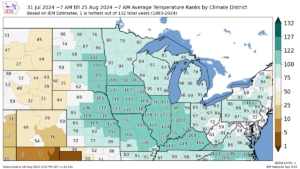
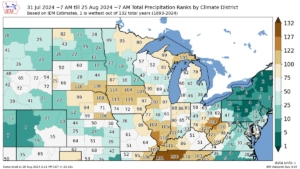
The two maps above show average temperature and total precipitation ranks by climate district, for the current month of August 2024.  Note how cool the whole corn belt has been for August.  We had the 105 warmest August in past 132 years, and the 107 wettest August in the same 132 years.  Note the drought area forming over Nebraska and Iowa…   Current forecasts are for continued cooler weather through the first week of September.  While this means very little stress on the crop, we are starting to push up against frost dates the longer this trend continues.

Crop & Weather Update:

  • Much of the corn crop in the area is at Beg. Dent to 1/8 to 1/4 to 1/3 milk line depending upon planting date and hybrid maturity.  As  mentioned above, this is behind the average and quite a bit behind from the past few years.  Soybeans are in the R6 (Full Seed) stage with some early planted fields, with early maturity varieties, just starting to get that off-green color.
  • Temperature forecasts over the next 10 days (out to Sep 4) are predicted to give us 250 GDU’s.  Add this to the above GDU numbers and we have the April planting date showing close to 2400 GDUs and the May 4 showing over 2300, and May 14 just over 2200 GDU’s.  These numbers are still shy of maturing 105 day hybrids.  In other words, we are still looking at needing, at the minimum, an average to above-average September to finish the corn crop as we have come to expect for best yields, etc.  Keep in mind, that the best yields usually happen when we accumulate more GDU’s than the hybrid is rated for, before physiological maturity occurs.  The longer we can extend grain fill, the heavier the test weights and the deeper the kernel which all adds up to increased yield….and better standability for harvest….   At this rate, harvest will occur later than we have experienced the past few years.
  • Something to keep in mind as we finish out the next few weeks…. for 250-300 bu. each day from R4 (Dough) to the end is worth 3.5-4 bushels. At half milk line (R5.5), it’s still accumulating up to 2 bu/day of kernel weight. At R5.5, you want to see green stalks to the ground, and green leaves from the ear to the top of the plants.   In other words, the goody (or ‘how much profit’) is still being determined over these weeks….don’t shutoff to early…
  • Sunlight has greatly improved over that past few days.  Hopefully this trend will occur over the next few weeks, as increased sunlight can help offset a little the lack of heat….
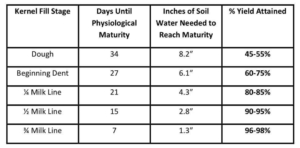
  • Water needs:  Below chart shows total water needs for corn during these last growth stages.    From the chart, it shows 1/4 mile line needing 21 days to maturity….which means we still have three weeks (and I would like to see 4 weeks for best tst. weights, etc.) before crop is finished….don’t shutoff too early.  At R6, soybeans still need 2-3 inches to finish.   All of these figures are dependent upon temperature and humidity
  • Disease Update: Corn – overall leaf disease pressure continues to be on the low side for infestations.  Southern Rust is around, but has yet to ‘blow up’ in the area.  Gray Leaf Spot and Northern Corn Leaf Blight are still present, but here too, we have not seen heavy outbreaks of either disease.  Soybeans – White Mold is starting to show up in some area fields, mainly in the lower areas of the field and those varieties prone to lodging.  Overall, we have much less pressure in area fields from this disease than last year.  SDS is beginning to increase in the area as well.  Again, many factors influence this disease such as soil conditions at planting, early stress that hampers root development and varietal tolerance.  High-rate Ilevo seed treatment works very well on this disease….we see very low levels of SDS in those fields treated for SDS.

Corn & Soybean Insect Update

  • Western Bean Cutworm larvae continues to be present in many sandy fields that were not treated.  As usually happens in cool summers, their flight has been very extended and we continue to see some small larvae show up in ear tips….not a lot, but they can be found in scattered spots of many fields.  Those fields that were treated are clean.
  • Spider Mites are showing up now in very low numbers.  However, we do not expect this insect to impact the crop.
  • Dectes Stem Borer numbers in area fields are again higher than they have been in the past.  This insect will be heaviest on field borders.  The main impact from this insect is loss of yield at harvest time from stems breaking off and no longer able to be harvested. Best management practice is early harvest before the stems get dry and brittle…keep this in mind as harvest nears.  See the link for more info: Dectes Stem Borer in Soybeans 
  • Soybean Aphids are showing up in heavier numbers than we have seen for many years…however, infestations have been spotty and overall insect levels have been low…but they are around…

Reminder that the Pioneer Innovation Plot Tour is scheduled for Wednesday evening, September 4th, with meal @ 6:30pm and plot tour @ 7pm.   Jim/Dave Schiltmeyer Farm south of Elgin on Hwy 14….then east on 838 Rd for 3/4 mile.   Come see the latest in corn hybrids from Pioneer, with the new Vorceed and Powercore technologies.

Please contact us with any questions or concerns you may have.  Thank you for the support!!

Starman Seed Service, Inc.