AGRONOMIC UPDATE: September 10, 2025….Approaching the Finish Line….
Topics:
- Growing Degree Unit Update/Weather Forecast
- Corn/Soybean Update
- Prioritizing Harvest….
- New Corn Hybrids for 2026…
TEMPERATURES & GDU ACCUMULATION:
As of September 9th, we have accumulated approximately the following for Growing Degree Units in 2025:
Planting Date GDD’s2025 Average GDD Departure from average
April 17 2577 2488 +89 (+5 days)
April 24 2526 2442 +84 (+5 days)
May 1 2479 2395 +84 (+5 days)
GDU accumulation has been below normal since the last update on August 19th. However, we continue to be ahead of the average, though we did lose 3 or so days since the 19th of August. Considering how cool it has been, this is not as big a loss as what was to be expected. This did give the crop a break, which was much needed back in August. Since the last update, we have accumulated average of 15 GDU’s/day, which is 4-5 GDU’s less/day than average. We should potentially see another 300+ GDU accumulation over the next 14 days if temps stay as forecasted. If this holds true, this means we will have accumulated 2700-2900 GDU’s by September 24th, which would mature most all hybrids regardless of planting dates….
Current Corn Conditions…..
- Current stage of much of the corn crop is as follows: Most fields are following the above GDU accumulation. 105 day and earlier hybrids planted before April 24 are 3/4 milk line – fuller season hybrids are 1/2-2/3 milk line. May 1 planting dates are 1/4-1/2 milk line. Most fields will take another 10 days (April planting dates) to 20 days (May planting dates) to finish, using average-to-above average temperature forecasts over this time period. The current 10-14 day forecast looks conducive for development, but it will be interesting to see how the hot temperatures and breezy conditions predicted over this period will affect overall plant health and staygreen. Both grain color and kernel depth look very good at present; however, these next two weeks will still be important for final test weight and kernel depth. Silage harvest is getting underway, and early indications are normal to above-normal tonnage….
- Below are a couple of photos showing impact of kernel depth and test weight on final yield….
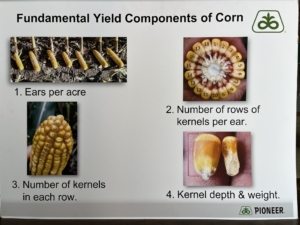
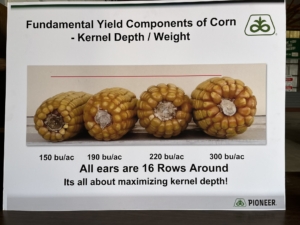
- Note the second photo showing size of ears. Note that all the ears are same rows around and kernel count, however kernel depth and weight is much different between the ears, with corresponding reduction in yield. We are still impacting kernel depth and test weights over the next couple of weeks….keep this in mind for last irrigations, etc…
- Sunlight: Solar radiation for all of the grain fill period, beginning in mid-July, has been below normal. We saw good sunlight in mid-August, but since the last week of August and into September, we’ve seen much below again. Sunlight plays a key role in kernel depth and test weight, as well as overall plant health. September 2024 saw much above normal sunlight which played a role in the good late-season plant health that we saw last year. So far in September this year, we are not having that luxury. This increases the potential for a negative impact on stalk integrity later into harvest for 2025, due to reduced photosynthesis going to overall plant health….this will be exacerbated by the high levels of disease present in most fields this year.
- Disease: As we saw in 2024, overall leaf disease pressure has been high this year….mainly Southern Rust; however, Tar Spot is starting to takeoff in some area fields. Most all corn fields in the area are ‘marked up’ with leaf disease. Even fields with fungicide are marked up to some degree, though much reduced versus no fungicide applied. The biggest drivers of disease right now is Southern Rust and Tar Spot. The cooler weather as of late has slowed Southern Rust down some, but it is still active and will increase in activity with the increasing warmer temperatures that are forecasted.
- While the 2025 crop is ahead in development versus 2024, it seems like area fields are losing their color a little earlier than last few years. This color change is due to crop maturity, but is also a reflection of the overall disease pressure and severity within the fields. Southern Rust does not overwinter here, so it is not usually a concern, however, if we get a lot of southerly winds, and/or hurricane outflow, we have a greater chance for this disease to develop. Southerly trade-winds were very active all summer which drew the disease into our area.
- As was to be expected, we have seen higher levels of, and earlier appearance of, Tar Spot in the area versus last year. Early infestation levels of this disease were low, but we are now seeing this disease really takeoff in some fields (and hybrids) over the past 10 days or so, and we would expect this disease to increase in infestation levels as the growing season reaches an end. While not having much impact on overall yield, this disease will be a big factor in late-season standability across hybrids and fields.
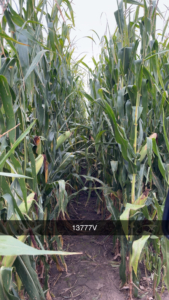
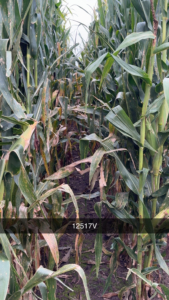
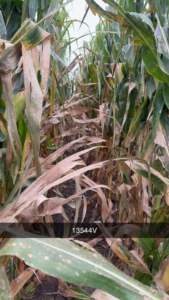
- This set of photos was taken September 9th, all from the same field. They show differences in Tar Spot tolerance across three Pioneer hybrids. We are seeing the P13777 family show very good tolerance to Tar Spot. For Tar Spot, Pioneer offers some of the leading tolerance, across their hybrid lineup, within the seed industry. We continue to see Pioneer show better tolerance than many competitive hybrids and brands. Besides the irrigated acre, keep this in mind for the dryland and more marginal acres, that do not see a fungicide every year…
- Due to the high incidence of disease pressure in 2025, we expect to see an impact on area corn acres this year, most likely in late-season plant health. See Prioritizing Harvest below for more info.
- Irrigation demand is slowing down, and we can see the end, but with the warmer temps coming it is still needed in the sandy soils and on the later planting dates (end of April & May)….even in the heavy soils, as black layer is still 2+ weeks away on these later planted fields. Keep in mind that 1/2 milk line corn requires 2.5″ – 3″ to finish….more in hot weather. ET rates will approach .30-.40+ over next few days as temps warm up and breezy conditions prevail. Keep this in mind over the next 5-7 days. If irrigation is planned, better to water earlier than later….Don’t shutoff too early….the longer it stays green, the better yield and plant health.
Current Soybean Conditions…..
- Soybeans are starting to turn in much of the area. Most fields are in mid-R6 to early R7. The early group II soybeans are really starting to turn now. Forecasted heat over next 5-8 days should move things along….
- Disease: Sudden Death Syndrome (SDS) is present in much of the area, with some fields showing heavier levels of infestation. White Mold infestations have been very light this year….caught a break here. Overall disease pressure in soybeans has been much reduced this year compared to prior few years.
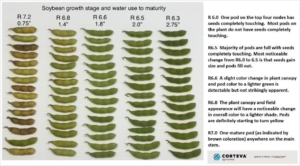
- Irrigation: Fields in the late-R6 to early-R7 stage need approximately 1.5-3″ of moisture to finish. For reference, the chart below shows soybean stage of growth at R6-R7. Don’t give up on that last watering…..
- Dectes Stem Borer. This insect enters the plant at a node and proceeds to ‘hollow out’ the stem leading to early plant death. So far not much one can do in the way of management for this insect yet. However, as with past few years, we expect this insect to be present in area fields. Keep this in mind as harvest begins and progresses. For more info see the following link….Dectes Stem Borer in Soybeans
Prioritizing Harvest!
The extremes in weather (very dry conditions at planting and emergence, consecutive days of high winds at V4-5, wet and cool summer with intermittent heat spells, reduced sunlight during grain fill, high disease pressure) in 2025 have the potential to impact late-season stalk quality. As mentioned above, diseases like Southern Rust & Tar Spot will have some of the biggest impact on stalk quality. Heavy fields of Southern Rust and late Tar Spot will be very likely to have poorer late-season stalk quality. Stalk rots appear each year with varying degrees of severity. They are caused primarily by fungi and bacteria, but they can also result from environmental stresses. When these diseases or conditions happen, they weaken or destroy vascular tissue in the stalk, and the plant cannot transport water or carbohydrates effectively, which ultimately results in premature plant death and reduced grain fill. The environmental stresses this year are putting more pressure on plant health. Watch for those fields that lose staygreen quickly, or that have ears drop suddenly, as these are signs of premature plant death. See photo for ‘ghost stalk’…..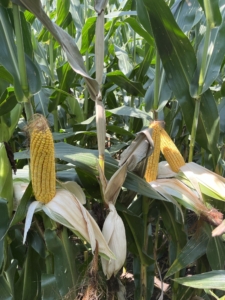
The longer the plant stays green, the better the standability will be as harvest progresses. Bottom line….there is a higher probability for the 2025 harvest to have significantly more issues with stalk integrity as harvest progresses, especially if sunlight stays reduced through September, limiting overall photosynthesis. This is one year where you want to be ready ‘to go’ at the first opportunity….equipment, labor, etc.
New Corn Hybrids:
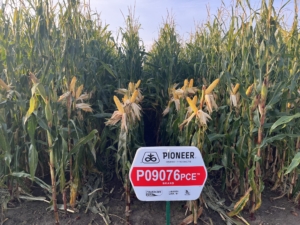
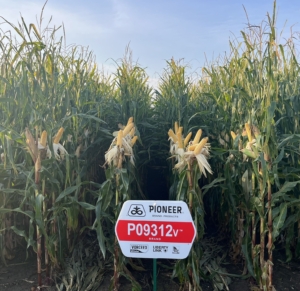
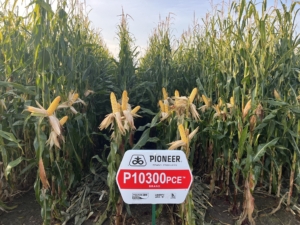
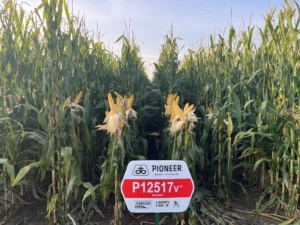
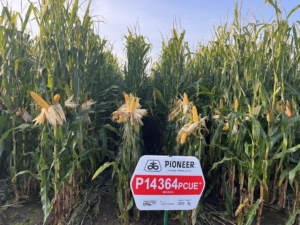
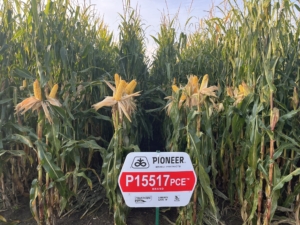
The above photos are some of the new hybrids for 2026 with a couple of the leader products from the show plot. For 2026, Pioneer has over seven new corn hybrids across the 105-115 day maturities. The photos above show some of these new products. Please contact for more information on these products.
In 2024, Pioneer introduced the new Powercore Enlist, Powercore Ultra Enlist and Vorceed Enlist technology in corn. All new hybrids from Pioneer, starting in 2025, will have the Enlist technology, with Powercore providing above ground protection like the current AM products, Powercore Ultra providing above ground protection like the current AML products, and Vorceed is the new corn rootworm protection with RNAi performance. These hybrids offer excellent drought tolerance (one new AquaMax hybrid) as well as good disease tolerance package, with very good staygreen and improved brittle and root scores. These are some numbers to watch as harvest progresses.
Please let us know any questions, or concerns, or comments you may have. Let us know how we can help as harvest gets going! Stay safe! Thanks for your support!
Starman Seed & Supply, Inc.