2020 continues to be full of surprises…many of the ‘not-so-great’ kind.   We are officially in a freeze warning for the next couple of nights.   What will exactly occur from this, one can not be certain…however, I have included a nice summary from our area Pioneer agronomist, Kevin Kowalski, on what to possibly expect….and what to look for….over the upcoming next few days.   This is specifically directed towards soybeans.  A freeze won’t hurt corn as the growing point is below ground.  However, the cold temps could still impact overall emergence and stands, as the plants will just ‘sit’ for the next few days leading to an increased chance for disease, etc. to impact the shoot, etc.   Also, expect to see some cold imbibition to possibly occur on any corn that has just been planted.  One positive from all of this, is that we currently do not have saturated soils.  Saturated soils would increase substantially the impact from disease, etc.   Also positive, is that our soil temperatures were very warm heading into this cold snap, so it take some time to lower the overall temps into the 40’s, which will help limit overall exposure.

Below are the comments from Kevin:

Accessing Freeze Damage on Soybeans:

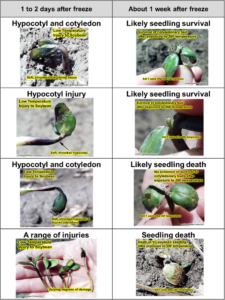
If air temperatures drop to high 20s/low 30s freeze injury could be expected to soybeans. Soybeans in low areas of the field are most likely to be affected. Plants should be assessed for damage at least 5 days after suspected injury to inspect for regrowth. If damage occurred above the cotyledons, the plant will likely recover. If damaged occurred below the cotyledons, the plant will not recover. Look for a discolored hypocotyl (the “crook” of the soybean that first emerges from the ground) which indicates that damage occurred below the cotyledons. If soybeans were not yet emerged at the time of the freeze, they should be fine.  Here are some pictures below to help guide you from Purdue U on frost damaged soybeans.


Some soybean key points:

  • Emerged soybeans are more susceptible to damage from freezing temperatures than corn because their growing points are above the soil surface
  • Several cool days can harden a plant and temperatures of 28 degrees can sometimes be better tolerated
  • Temperatures below 32º F can cause frost damage to emerged soybean plants, while temperatures below 28º F for an extended period of time (>4 hrs) can be lethal, especially on lighter-textured soils.
  • Heavier-textured soil can better store and release previously accumulated heat near the soil surface when air temperatures drop, helping to protect recently emerged soybean plants.
  • High levels of residue on the soil surface can increase the risk of freezing injury by reducing the transfer of heat from the soil to the plants.
  • A soybean plant at the cotyledon stage has three growing points –the main shoot and two axillary buds at the base of the cotyledons. Recovery from freezing injury is possible as long as at least one of these buds survives.
  • Soybean seedlings that have just cracked the soil surface will be more tolerant to freezing temperatures than plants at the cotyledon or unifoliate stages.
  • The cotyledons are full of solutes making them good buffers protecting the three potential growing points between them, making them more resistant to injury and therefore soybeans at VC stage are slightly more frost tolerant compared to V1-V2 stages
  • Freezing damage that extends below the cotyledons will result in the death of the plant.
 

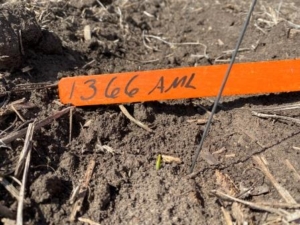
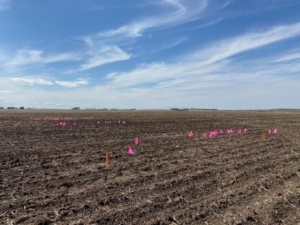
Pioneer, we have….emergence!   First planted corn is starting to emerge.   Here are a couple of photos from a plot planted April 21st.   The first photo shows a newly emerged plant on P1366AML and the second photo shows our emergence trial.  The flags represent emerged plants.  We will be checking this plot each day and flagging emerged plants with a different colored flag to mark the different emergence dates.  We will follow up on this throughout the year and show results at our field days later in the summer.  We are tracking five different hybrids in this plot with different stress emergence ratings.  The flags in the foreground are from P1563AM, then P1366AML and the bunch towards the back is from P1138AML.  All three hybrids are good at getting ‘out-of-the-ground’ early.   Almost all of the P1138 is up already.   Look for more updates as the growing season progresses.  Have a great week!  Stay safe!

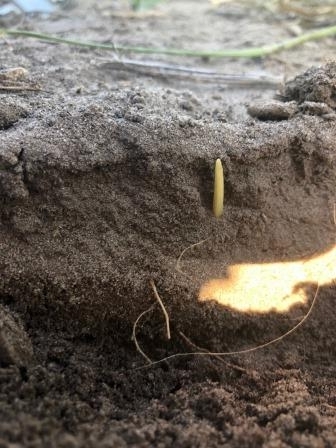
Short video on what is currently going on in our fields.   The video is from the evening of April 30th, so does not reflect the heat of today.  Overall, things are looking good on corn germination, etc.  GDU accumulation as of April 30th is 104 GDU’s for an April 21st planting date and 77 GDU’s for an April 23rd planting date.  Today’s heat will add 20+ GDU’s to these totals.   We would expect some of the early planted corn to emerge possibly early next week.  Overall soil moisture in the seed zone on corn and soybeans in the heavy soil is good….keep an eye on sandy knobs as the seed could be in dry soil here.   Top 3/4 to 1 inch of soil is very dry….this is a concern for pre-emerge herbicide control.   Pre-emerge herbicides will need to be re-activated by Monday again if no rain over the weekend.  Main concern for moisture is for herbicides….it will be a good idea to make another round on both crops early next week if no rain….total amounts to apply will need to be in the .60-.75 inch as anything less will just be soaked up by the dry topsoil.  Picture is a shoot of P1197AM ready to emerge in sandy soils.  Thanks to Scott Wright for the picture!

WATCH VIDEO:  4-30-2020


Needless to say, we are living in some interesting and challenging times, as we live out Quarantine Day #!?!?….a little humor to get started…..

I’m sure we can all relate to this comic strip….especially those who have children in the house ALL DAY…..

We hope and pray that everyone is doing well, staying healthy and safe, and prepared for the planting season!

Topics for this Update:

  • Temperature, Soil Temperature and GDU accumulation.
  • Cold soils and Corn Emergence
  • Things to Keep in Mind when Planting Early
  • Hybrid Stress Emergence Ratings

TEMPERATURE

The below two maps show the temperature probabilities for the 6-10 day and 8-14 day forecasts:

The next two maps show the 8-14 day precipitation probability forecast and the weekly average 4-inch bare soil temperature on 4/13/20

As we can see, the forecast for the next 7-14 days is for a warming trend with slightly above normal precipitation in this period.  This bodes well for getting some corn/soybeans planted in April.  It will be interesting to see what the precip forecast does over the next couple of weeks.

Notice as well the soil temperature map.   We see that the weekly average on 4/13 was 49 degrees….keep in mind this is bare soil.  This means that soil temperatures were warming up quite nicely before this current cold spell.  I would expect however, to see this weekly average fall to the upper 30’s or lower 40’s by Saturday am.   Also, GDU accumulation from March 1 to April 13 for this year is 131 GDU’s.  While the specific number doesn’t mean much right now, it does show that we have had some heat over the past six weeks….during this same time frame in 2019 we had zero GDU’s accumulated.  All of this means that soil temperatures will rebound quickly once we experience a period of warmer temperatures.  We are in better shape than a year ago at this time heading into planting.

COLD SOILS AND CORN EMERGENCE

Optimal soil temperatures for planting corn is 50 degrees and above.   Keep this in mind as we head into next week and then see what the average soil temperature has done over the past seven days.   Imbibition of cold water can lower germination rates and cold soil temperatures can delay emergence allowing for more diseases to set into the seedling.  Watch the forecast if it looks like we will get into the 60’s and 70’s our soil will warm up relatively fast.  Here is a quick look at how a seed germinates.  Imbibition of soil water happens within the first 48 hours and is why it is critical to plant when soil conditions and soil temperatures are right.  Main to keep in mind is that best time to plant is into a 2-4 day warm temperature period after planting.  Most reduced stands occur when planting into a cold spell or before giving the soil temperatures time to warm up some right after a cold period.

See link for further information:  Corn Soil Temp and Emergence

THINGS TO KEEP IN MIND WHEN PLANTING EARLY

  • Fluctuating soil temperatures can cause imbibitional seed chilling, erratic emergence and cold temperature injury
  • Average last freeze date:  3rd-4th week in April for Central Nebraska
  • Soil may be too wet which can lead to side wall compaction, crusting and poor seed to soil contact
  • Herbicide injury can occur more often in cool, wet soils where the plant isn’t growing at an optimal pace
  • Soil temperature fluctuates more in the top 1” = one reason why we plant at 2”
  • Seed to Soil contact is key to fast emergence and stand establishment

PLANT FIRST RECOMMENDATIONS

One of the most frequently asked question is “What product should I plant first?”  With the cooler soil temperatures at the beginning of planting we believe that it is important to start with a hybrid that shows strong emergence and early vigor.  The below bullet points show our recommendations for “plant first” products if soil temps are cool. The hybrids are listed by maturity not by how well they emerge.  These are products that have shown to have strong emergence and early vigor over the past several seasons.  Selecting one of these hybrids to start with can help provide the best chance for optimum emergence when soil temperatures are cooler at the start of planting.   However, considering how fast our soil temperatures should warm up this spring, and if one is planting into a warm stretch, we don’t have an issue with starting with most any hybrid.  Keep in mind the 2-5 day forecast ahead of anytime you are planting.  Remember also, that we will continue to experience soil temperature fluctuation as we go through planting.

  • 105-109 CRM – P0421, P0589, P0622, P0950
  • 110-118 CRM – P1082, P1089, P1108, P1138, P1244, P1379, P1563, P1828

Please contact us with any questions or comments you may have.  Thank you!!