AGRONOMIC UPDATE: August 20, 2025….Dependent upon Mother Nature now….
Topics:
– Temperatures & GDU Accumulation
– Corn Update/Water Usage/Weather Update
– Corn/Soybean Insect Update
TEMPERATURES & GDU ACCUMULATION:
As of August 19th, we have accumulated approximately the following for Growing Degree Units in 2025:
Planting Date GDD’s2025 Average GDD Departure from average
April 17 2247 2089 +158 (+8 days)
April 24 2196 2043 +153 (+8 days)
May 1 2149 1996 +153 (+8 days)
We have seen a big increase in GDU accumulation since the last update on August 3rd. We are now ahead of normal by just over one week. This is reflected in the current corn crop’s stage-of-growth versus this same time last year, as will be noted below. At this time last year, we were right at the normal for GDU accumulation. However, this increase in GDU accumulation has come with a potential cost, as most of the reason for this has been higher than normal nighttime temperatures….more on this below in corn discussion.
Forecast next 7-14 days:
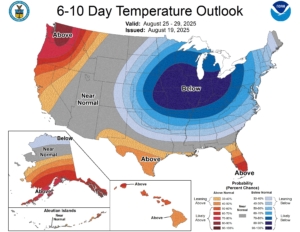
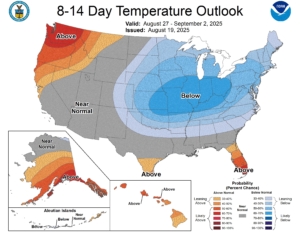
The above maps are 6-10 and 8-14 day temperature outlooks – August 19 forecasts. We usually hesitate to post these as they seem to changed day-to-day. However, most weather forecasts are very consistent in these maps with trend for this to continue through the rest of August and into early September. What this means, if this comes occurs, is that we will lose the gain we show from the above numbers. The good from this is that crop development will slow down some allowing for longer grain-fill period. The negative from this will come from just how long this cool period lasts. The longer it lasts, usually means lower test weights, especially if occurs with reduced sunlight. Disease development will also be impacted as Southern Rust will slow down, but increased potential for Northern Corn Leaf Blight will grow substantially. As usual, what is gained from a change in environment leads to increased potential for something else to occur….overall this is not a forecast to add bushels to the corn crop….
CROP UPDATE/WATER USE/WEATHER UPDATE
- Crop conditions: Much of the Corn crop in the area is in the Beg. Dent to Full Dent to 1/8 milk line on some hybrids. L:ast year at this time, corn was Late Dough to Beg. Dent, so we are currently ahead of 2024. Soybeans are ahead of last year, mainly due to the early planting and the amount of acres planted before May 1. Early soybeans are in the R6-R6.5(full seed), with May planting dates in the R5-5.5(Beg. Seed) stage. These stages-of-growth track with the above GDU accumulation of one week ahead of normal.
- The hybrids that we currently plant today, perform best with a long grain-fill period….they still need four weeks of fill once crop reaches full-dent for highest test weights, kernel depth, and good late-season plant health.
- Relative Humidity – Over the past two weeks, RH has been running above normal, in fact 8-10% above normal. Average RH has been mid-70’s t0 mid-80’s. This is higher than 2024. Higher RH usually mean lower ET rates. Higher overall RH though, usually has a negative impact on disease. However, temperatures, winds, rainfall, all play a role here as well.
- ET rates – ET rates over the past 7-10 days have been the highest we have had so far this summer; however, due to the high RH, they are still trending below the average by .05/day. Soybeans were actually pulling harder than corn over the past two weeks. The cool temperatures forecasted for the rest of August will dramatically lower ET rates. Keep this in mind as you think about irrigation over the next 7-10 days. See tables below for Water Use for soybeans and corn as we head into the main part of grain fill period. Corn and soybean needs are still for 4-8″ to finish depending upon planting date and stage-of-growth. Right now we are in a much different place than this time last year, where August and September were warmer and dryer than normal….
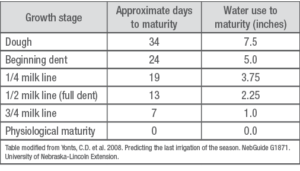
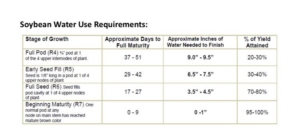
- Sunlight – As always sunlight becomes a major player during grain-fill for both yield and late-season plant health.
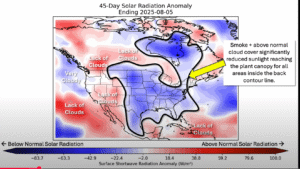
- The above map shows the solar radiation anomaly for the past 45-days. While this map is just one data-set, it does show a general trend of lower sunlight for July and first part of August. That trend has continued through the current month. We always stress how important sunlight is for kernel depth and test weights, but it plays a big role in overall plant health. Compared to 2024, August of 2025 is trending behind….hopefully this changes as we get into September.
- Diseases – So far the 2025 growing season has caused our fields to be a petri dish for disease development, especially corn fields. We continue to see Southern Rust progress in area fields, even in those fields which had a fungicide applied to them. However, there are very noticeable differences in disease levels between treated and untreated, with untreated fields showing much heavier disease pressure than treated fields. Also, expect overall fungicide control to be more variable this year compared to last few years due to environment, application timing and coverage. We will know more on how well fungicides performed over the next couple of weeks.
- We continue to monitor for Tar Spot. We continue to see this disease show up in higher levels than last year, but we are not seeing it just ‘blow up’ yet. Greatest impact from this disease will most likely be on late-season standability. We will update for any impact on harvest as the growing season progresses to the finish line. As mentioned above in the temperature comments, keep an eye out for increased Northern Corn Leaf Blight lesions. While normally not much of an issue for us in our warmer climate, the forecasted temperatures are conducive for this disease to increase. Starting to see some Goss’s Wilt show up in the hailed areas. Bottomline, disease will impact both final yield and harvestability for 2025.
- For Soybeans, we are just now seeing a little White Mold show up in some fields. Overall levels of this disease are very low considering the growing season so far. This disease should not be an impact on irrigation management. However irrigation management moving forward in soybeans this year, will have more to do with lodging than disease. SDS is showing up in our area once again. We continue to see increased levels of this disease each year. Monitor fields for this disease and plan on seed treatment for next year in those fields showing high pressure. In general though, overall disease in soybeans is low….
CORN/SOYBEAN INSECT UPDATE
- Spider Mites – Currently we are finding spider mite colonies in many area fields, very low numbers overall. However, in conventional corn/white corn/popcorn fields are showing up with higher numbers due to earlier treatments for corn borer and western bean cutworm. The forecasted cooler temps should really slow this insect down.
- Corn Leaf Aphids – We are seeing higher numbers of Corn Leaf Aphids in most corn fields. They proliferate in high humidity conditions. They are not a cause for concern….just more of a nuisance when walking through fields.
- Western Bean Cutworm – We are still seeing low numbers of larvae in ear tips on those fields not treated. While overall numbers have been low, they are still present in some areas.
- Soybean pests – so far, insect activity in soybeans continues to be very light. We are seeing some soybean aphids, but low numbers overall. Expectations for major outbreaks of these pests are low….or, really outbreaks of any kind in soybeans at this stage.
Video of Interest…..Rat Tailing in Corn – Local Observations….
We are seeing a little of this in area fields. Two things can cause this type of injury….herbicide (specifically growth regulators) or mechanical injury such as hail, wind (think of those days in mid-late May that were so windy), plant being driven over, etc.,….these can cause injury to the growing point. Most of what we see leads us to think herbicide….
If you find these symptoms in your field, look up spray dates, weather conditions at time of spraying, herbicide rates used, etc., to see if any pattern develops. Hybrids differ in there tolerance to growth regulators as well. Not a big factor, just observations….
Reminder that the Pioneer Customer Appreciation Supper is this upcoming Friday evening, August 22nd. Pioneer warehouse – Elgin, NE….5:30-8:30. Bring the family! See you there!
Plot tour is scheduled for Wednesday, September 3rd….
All for now! Thanks for your time!