Topics:
- Growing Degree Unit Update
- Quick Crop Update/Water Use/Weather
- Corn/Soybean Insect Update
TEMPERATURES & GDU ACCUMULATION:
As of August 15th, we have accumulated approximately the following for Growing Degree Units in 2024:
Planting Date GDD’s2024 Average GDD Departure from average
April 23 1997 1987 +10 (even)
May 4 1913 1904 +9 (even)
May 14 1818 1804 +14 (+1 day)
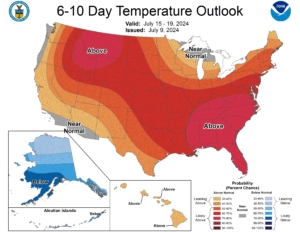
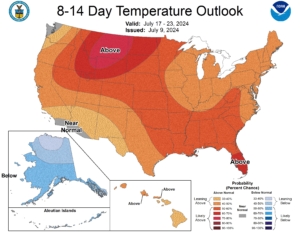
As has been the case all this growing season, GDU accumulation continues to be average. We continue to see cool and then warm periods for temperatures; warm temps are forecasted over the next 10-12 days. We will go from below normal temps to above normal temps. The last 7-10 days have seen around a 5 GDU/day reduction versus the average for this time of year. Normally we should average 21-24 GDU’s/day, but we averaged 14-18/day the past week or so. Forecasted temperatures for the next 10 days are forecasted to be normal to above normal, so we should see an increase of daily GDU accumulation back in the average range of 20-25 GDU’s/day. The warmer temps are much needed to keep the crop moving along. We are slightly behind 2023 and behind 2020-2022 by a week or so. If the rest of the growing season tracks average, we should expect black layer for April planting dates around Sep 25 and the mid-May planting dates will need into the first week of October.
CROP/WATER USE/WEATHER UPDATE
- Crop conditions: Much of the Corn crop in the area is in the late-Dough to Beg. Dent stage, with some early maturity hybrids just showing the beginnings of a milk line. Soybeans are in the R5(Beg. Seed) to late-R5 to almost R6(full seed). These stages-of-growth track with the above GDU accumulation as average. The hybrids that we currently plant today, perform best with a long grain-fill period….they still need four weeks of fill once crop reaches full-dent for highest test weights, kernel depth and good late-season plant health.
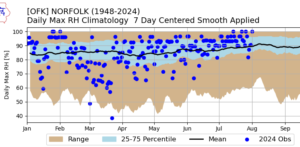
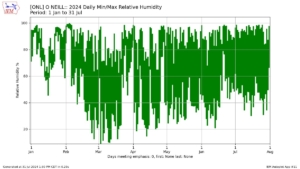
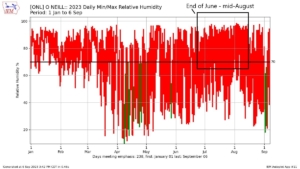
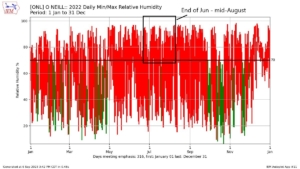
- Relative Humidity – Over the past two weeks, RH has been running normal to above normal. Average RH has been 72% which is slightly above normal. This is very similar to last year. Higher RH usually has a negative impact on disease, however, temperatures, winds, rainfall, all play a role here as well. Compared to last year, we are seeing less disease in soybeans, both white mold and SDS, but an increase in corn diseases (southern rust, gray leaf spot). Overall ET rates are lower with high RH.
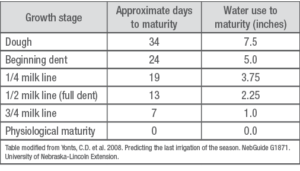
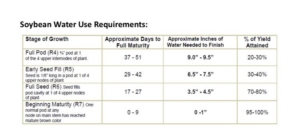
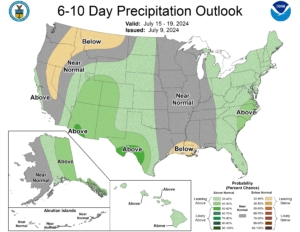
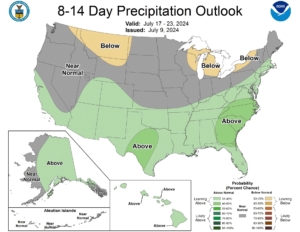
- ET rates – ET rates over the past 7 days have averaged .17″/day, or 1.2″ total for this period. This figure is .05/day behind the average of .22/day. Again, for reference, during this same time period in 2022, average ET rate was .27/day. The cool temps with high humidity has helped reduce ET rates. However, temperatures over next two weeks are forecasted to warm back up and humidity is forecasted to be lower, which will increase ET rates again to more normal to slightly-above normal. Watch forecasts, and note those days which are predicted to be high temps, with low humidity and breezy conditions, those days will have the highest ET rates. See tables below for Water Use for soybeans and corn as we head into the last half of grain fill. Corn and soybean needs are still for 6-8″ to finish depending upon planting date and stage-of-growth. Unfortunately, forecasts for this same period are for dry conditions, so irrigation will still be high over the next four weeks, considering that the crop will need most all of September to finish for the best test weights, deep kernel, and plant health.
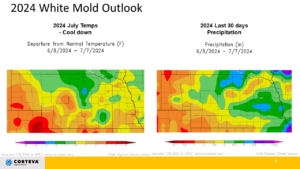
- Precipitation – Compared to last year, we are very much on the dry side for July and the first half of August. See maps below for a comparison of July precipitation for 2024 vs. 2023:
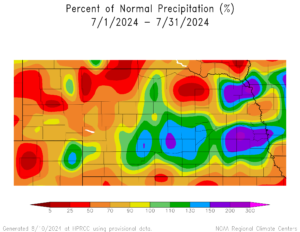
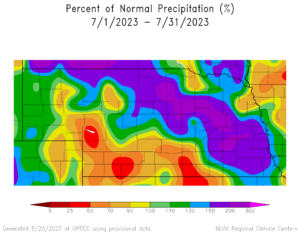
- Note how much drier July 2024 has been versus July 2023. This is impacting our dryland acres even with the increased rainfall from this spring. This is also playing a role in reducing white mold in soybeans versus last year, even though relative humidity has been higher than average.
- Sunlight – As always sunlight becomes a huge player during grain-fill for both yield and late-season plant health. Solar radiation, believe it or not, was slightly above normal for July. However, we did have a number of smoke-filled skies in July, which lowered overall solar radiation. This should be a positive to both grain-fill and plant health. The first two weeks in August were below average. Conditions are forecasted for more sunny weather for the rest of August, this will be good thing as we finish grain-fill…..
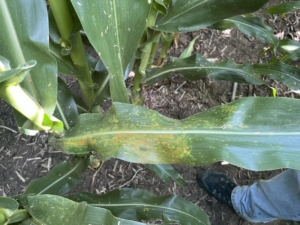
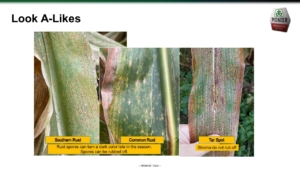
- Diseases – So far corn diseases have not greatly increased in the area. However, we are finding the most Southern Rust in the area since 2006, which had very high levels.
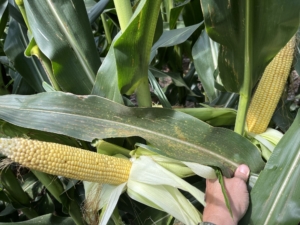 This disease bears monitoring over next few weeks as it’s greatest impact will be on late-season plant health. Those fields which show the highest incidence of the disease will be a prime candidate for early harvest.
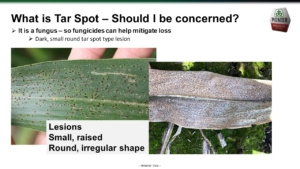
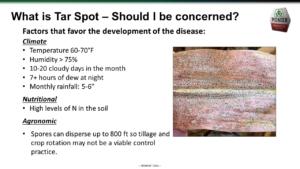
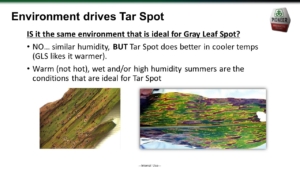
 - Another diseases to monitor over next few weeks will be Tar Spot. We are seeing first lesions in the area this past week.
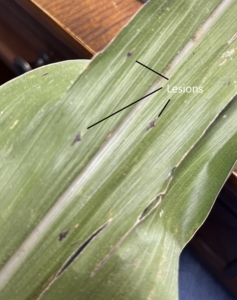 Impact from this disease will also be on late-season standability. We will update for any impact on harvest as the growing season progresses to the finish line. Also seeing some Gray Leaf Spot starting to come in on lower leaves in some fields, along with Northern Corn Leaf Blight lesions showing up in hybrids that are not as tolerant to this disease. Starting to see some Goss’s Wilt show up in the hailed areas. Overall leaf disease in corn is higher than the past few years.
 - For Soybeans, we are just beginning to see the White Mold show up in some fields. Overall levels are much lower than at this time last year. Forecasted temperatures will most likely keep this disease down overall, however, there could be local areas of heavier pressure. SDS is also starting to show up in our area, but, as with white mold, the overall levels so far of SDS are reduced compared to last few years. Overall disease levels in soybeans are low….
CORN/SOYBEAN INSECT UPDATE
- Spider Mites – Currently we are finding very little in the way of this insect versus the past two years, which is due to the cooler/wet conditions. However, if temps increase, precip falls off, and RH is drier, we could still see isolated spots of this insect make an impact towards the end of grain fill.
- Corn Rootworm Beetles – we continue to see much reduced numbers of adult corn rootworm beetles versus the past few years. This will be a positive to overall corn rootworm larvae infestations as we head into 2025, meaning much lower levels for next June.
- Western Bean Cutworm – the WBC moth flight has been very extended this year, and while overall numbers have been less than normal, we are still seeing low numbers of larvae in ear tips on those fields not treated.
- Soybean pests – so far, insect activity in soybeans continues to be very light. Just not seeing much for soybean aphids or bean leaf beetles so far. Expectations for major outbreaks of these pests are low, or anything else in soybeans at this stage, are quite low….
PICS OF INTEREST….
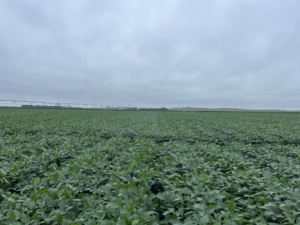
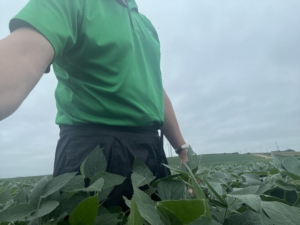
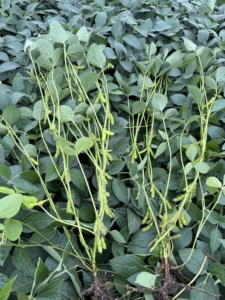
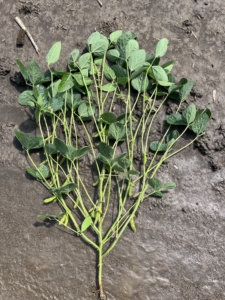
Pictures of Enlist variety P22A67E….clean field, nice plant height (waist high) with a lot of branching! Zero white mold. First three photos taken on August 12, same field. Last photo is P22A67E taken on different field on Aug 9th. There are a lot of nice soybean fields in the area….
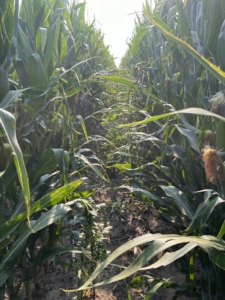
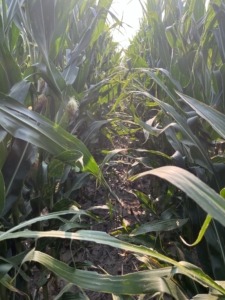
These two photos show just how little light Palmer/Waterhemp needs for growth. First photo is just a wide row from planting….2nd photo is next row over. Note how clean the row is where normal canopy versus just a touch wider….
Reminder that the Pioneer Customer Appreciation Supper is next Friday evening, August 23rd. Pioneer warehouse – Elgin, NE….5:30-8:30. Bring the family! See you there!
Plot tour is scheduled for September 4th….
All for now! Thanks for your time!
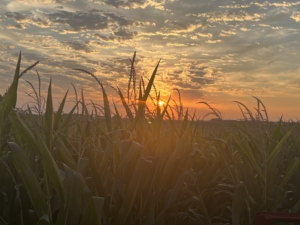

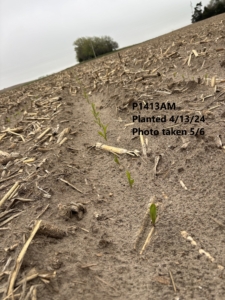
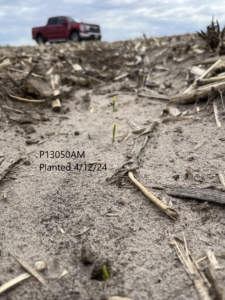
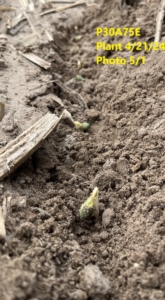 (second corn photo was taken on 5/1)
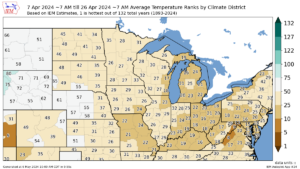
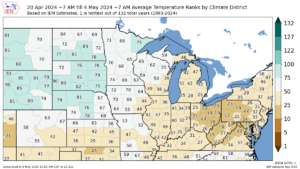
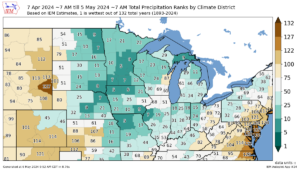



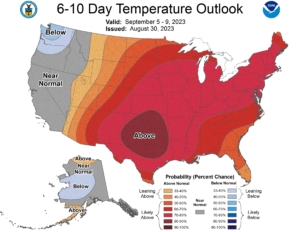
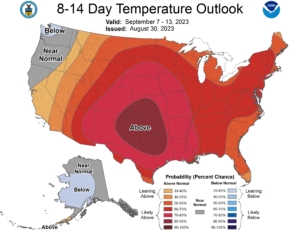
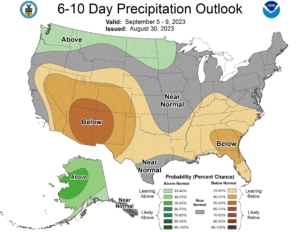
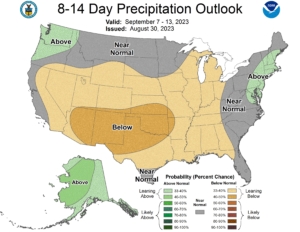
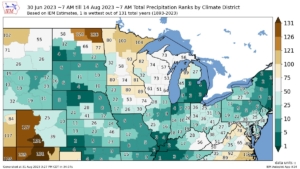
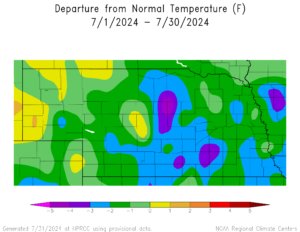
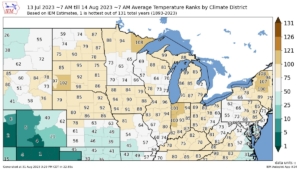 The first map shows the total precipitation by climate district from July 1 to August 14. From the map we can see that Northeast NE saw the 9th wettest out of the last 131 years during this time period….so first condition, wet, humid turned true (thankfully so though considering how dry we were before this and how dry we are now). The second map shows average temperature ranks by climate district. Here, Northeast NE saw the 92nd coolest period out of the last 131 years….second condition met…cool temps. All of this allowed for high development of this disease and increased potential for plant lodging which compounds things even further. Add this to a low tolerant variety and/or no fungicide application, and infestation levels turned out high. From our observations, timely applications of Aproach fungicide has offered good control and slowed the disease down. See photo….
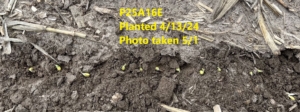
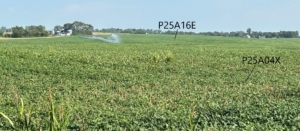 this photo shows P25A16E Enlist next to P25A04X Xtend soybeans. Two different growers but both fields side-by-side. P25A04X has good tolerance rating and that field was treated 2 times, but with a different product than Aproach. The P25A16E’s were treated twice at 9oz rate with Aproach. As you can see in the photo, the P25A16’s look green and clean compared to the A04’s. In heavy pressure White Mold years, what product one uses to give control is a very big deal….
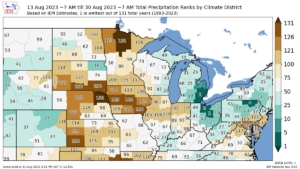 This map is the precipitation rank by climate district for the past two weeks. Northeast NE has had the driest on record for this time frame. Couple this with the above normal temps, and we can see why dryland has been hurt and starting to see ear droppage in some irrigated corn fields. Table below shows the approximate amount of water needed to reach maturity. Keep in mind that temperatures and Relative Humidity play a role in these amounts. We are still needing another circle into next week for most late-April, May planting dates…especially with the continued heat….
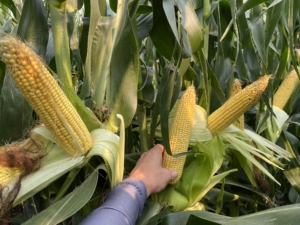
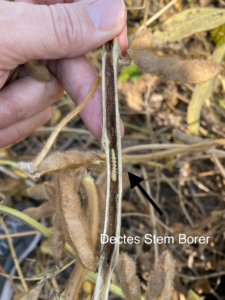 This insect enters the plant at a node and proceeds to ‘hollow out’ the stem leading to early plant death. So far not much one can do in the way of management for this insect yet. We saw a high incidence of this insect in our area a couple of years ago. Expectations are that we will have higher levels this year. Keep this in mind as harvest approaches….timely harvest will limit the economic impact of this insect.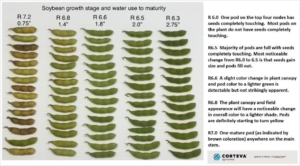
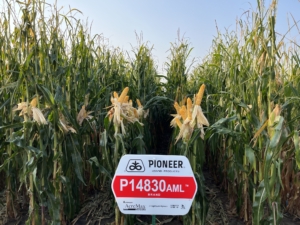
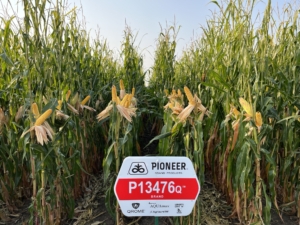
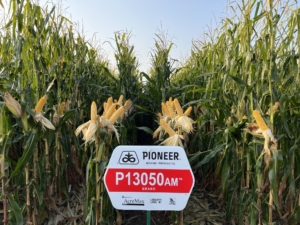
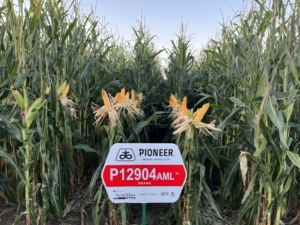
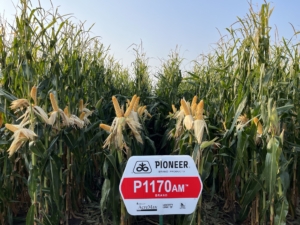
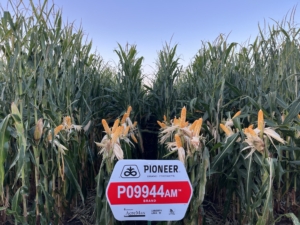
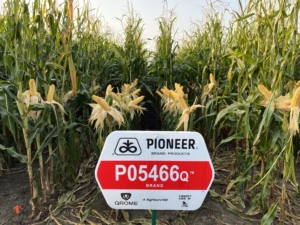
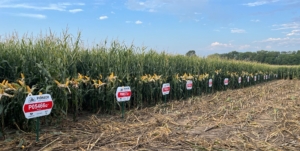 The photo is from the 2023 Pioneer Show plot. There are 7+ new corn hybrids for our area going into 2024. If you would like to go through the plot, please contact us and we will be happy to take you through. Also, expect to hear more as fall progresses on the next series of soybeans from Pioneer….the next series will be launched this fall.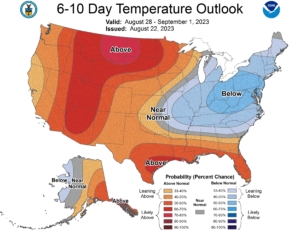
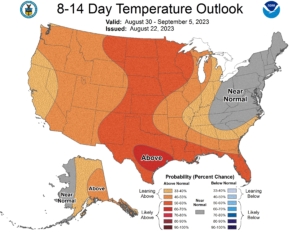
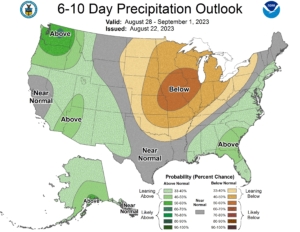
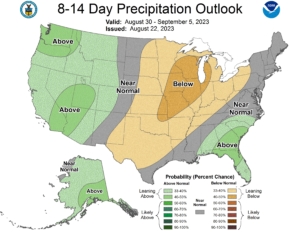
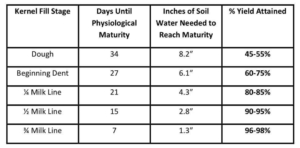 One positive is that most irrigated soil moisture profiles in the heavy soils are in good shape if irrigation has occurred over the past week….this means not that many circles are left, but we don’t have enough in the profile to finish the crop like we would want it to finish. At R6, soybeans still need 2-3 inches of water to finish and they have been pulling harder than corn. All of these figures are dependent upon temperature and humidity.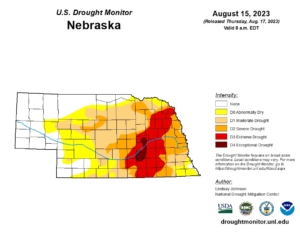
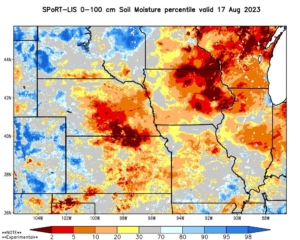 These two maps show the latest drought monitor map for Nebraska and soil moisture percentile deficit for the western corn belt. While this is just FYI, please note that, while drought conditions have improved, our subsoil profile overall is still below normal for much of Nebraska and Iowa and the north eastern corn belt.