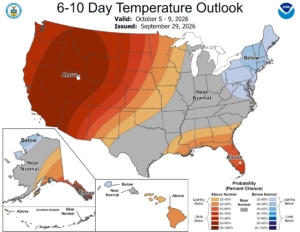
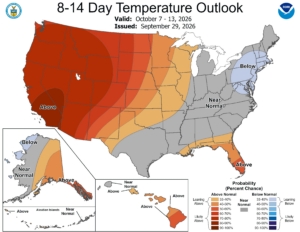
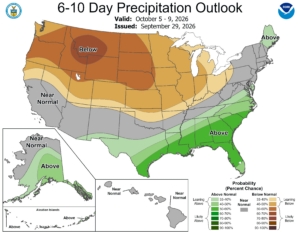
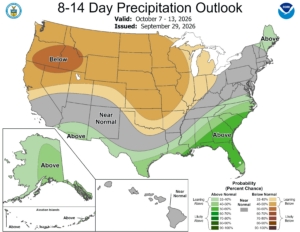
With the wet weather we want to start with some positive trends….the 6-10 and 8-14 day forecasts are very positive.
While we don’t put a lot of store in these maps shown below, we will take anything that forecasts warmer temps and no precipitation! It does look like we will get a window of harvest weather over the next 10-14 days….we should get some warm days in October yet….
Topics:
- Harvest Priorities….
- Tar Spot….affects and thinking about next year….
- What’s New from Pioneer….
HARVEST PRIORITIES:
- Wet soil conditions, poor stalk quality due to disease, and very little weather conducive for corn drydown, is setting us up for a longer harvest than normal, and with many issues we have not faced for a long while. We want to update on you what current crop conditions are like and try to leave you with some thoughts to increase productivity during this harvest season.
- Mother Nature has not been kind to us over the last few weeks with the wet conditions….fog, drizzle, clouds, rainy. What was already shaping up to be a harvest we have not been used to compared to the last many years, has the potential to be a harvest (especially the end of harvest) we have not seen for a couple of decades….
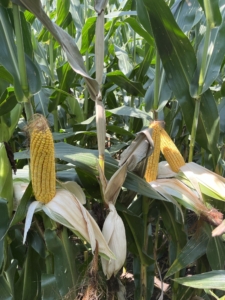
- Plant health in corn. Overall health for this time of year is the poorest we have seen in a long time, and in this large of an area to boot. As you drive the countryside, you notice most all corn fields are brown….this is true from here to Omaha and east. Our corn crop looks like it is November 1st (normally we have 70% harvested by Nov. 1 and this year it is less than 2%) and we need to think of it that way, even though it is the 1st of October. There are many reasons for why the crop looks like this with Tar Spot being the biggest (more on this below). Despite the best efforts we could do with fungicides, etc., Mother Nature is winning the battle for this year, on crop staygreen and standability.
- First thing….machines should be running somewhere, regardless….even if that means combing corn in the morning, switching to soybeans for the day….going back to corn in the evening. We know this is extreme, but both crops will be crying out to harvest me now….The ability to harvest soybeans before going to corn, before corn has an issue, may not be available this season.
- Should I leave soybeans and go after corn?….everyone’s situation is different, but keep in mind that harvesting down corn is a SLOW process that typically results in higher harvest losses. May want to pencil out insurance coverage for both crops when considering this question…
- Current conditions will limit crop dry down. Expect higher harvest moistures than typical vs. the past years. Hopefully we will get some weather to help get manageable moistures over the next week or so. Keep in mind also, that when a crop finishes fast due to stress or disease, dry down is usually slower than normal to begin with. From past experience, diseased fields and/or down corn, dry down at a slower pace.
- To get the crop out more timely, one may have to put the crop into a grain bin at a higher moisture level than comfortable with (and plan to move by Dec/Jan as well) just to get it out of the field with as little of harvest loss as possible (again, insurance coverage may play a role here). Higher harvest losses will mean a higher potential for volunteer corn, with ensuing rotation to soybeans for 2027 to control that volunteer.
- Bottomline….current conditions are pointing to harvest conditions unlike we have experienced for many years. As we mentioned in earlier updates, being flexible in your harvest priorities will pay dividends as harvest progresses. Making sure both equipment and storage facilities are in shape will be important.
- Patience & Safety. While this harvest will be sure to try one’s patience, having a plan and knowing what one faces, helps with patience. In this harvest season, please keep safety upper most in your thoughts….no crop is worth an injury to, or the loss of, a loved one….
- The excessive moisture and constant damp conditions of past weeks is speeding up the breakdown of plant residue. We will not experience the heavy residue of this past spring going into 2027 planting. Those stalks harvested already will be black in two weeks and crop residue will be MUCH less than past years heading into winter….won’t be as much ‘feed value’ out there for cows vs past years. Expect combines to be covered in ‘black’ mold/tar spot residue as harvest moves forward as well.
- Ear Molds: the prevalent wet conditions are leading to a concern about ear molds developing at a quicker pace. Ear molds were already present before this foggy, wet weather set in, and these conditions are increasing the amount of ear molds in area fields. If you have questions/concerns about ear mold, please call. This link has excellent information about ear molds and handling them…An Overview of Ear Rots
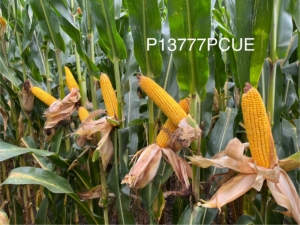
- Video links of the Pioneer show plot showing what to look for on plant/stalk health. Stalks on 9/28 P13777 & P14270 Stalks on 9/28 P11056 vs. weak Tar Spot hybrid
- When you view the links, keep in mind that the ‘whole field’ may not look like this, as I was in an area of higher elevation, which is impacting Tar Spot severity within a field….see bullet point on leaf wetness below for more info….
Tar Spot:
No denying it. Tar Spot is looking to be a ‘game changer’ in our area moving forward, both in impact and management of. Below are pictures from Satellite imagery showing affects of fungicide applications, irrigation timing, etc., on Tar Spot. There will be much to learn this year on this disease, and no one ‘thing’ from this year will be a ‘cure-all’ for Tar Spot. However, the images below will help with management decisions for next year. As you look at these images, keep in the mind the dates posted above the images, as this will give an idea on how fast this disease moves late in the season….
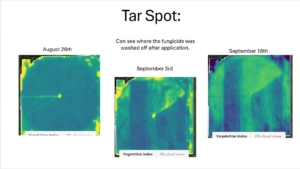
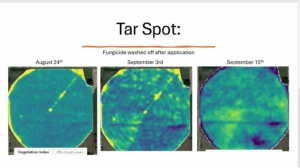
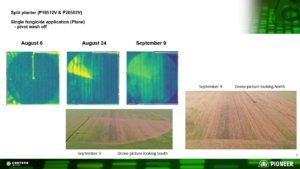
The three images above show the affect of watering to soon after fungicide application. Need to leave systems off at least 6-12 hours before starting, more if possible.
Two-pass fungicide….
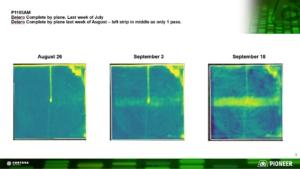
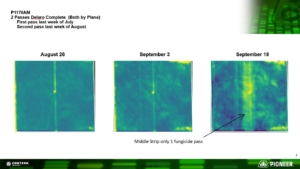
These photos show strips in the middle of the field that were not treated with a second fungicide application. The strip in the middle is one-pass and the rest is two-pass. Note again, the rapidity with which Tar Spot moves…
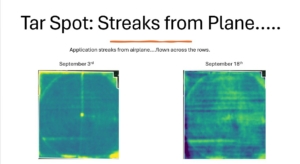
Seeing and hearing a lot on application methods, etc., in area fields. The above photos show streaks from plane application. We see streaks from Drone applications as well. We also see good spray patterns from planes and drones as well…not every field is the same….plane, drone, pivot applications can all work, but like anything, how effective of control one may get depends upon environmental conditions, applicator and timing….
Ready or not, much to learn this year….
Moving forward:
- Have to start with right genetics. If not planting the best tolerance genetics, one starts out behind the proverbial ‘8-ball.’ Playing ‘catch-up’ throughout the growing season…reacting to, rather than managing for….
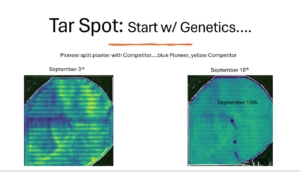
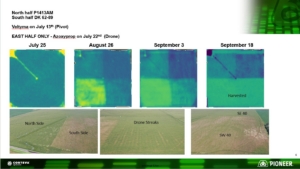
- The first image shows a split planter trial of Pioneer and Competitor. One can see the difference even late-season. Two-pass fungicide through the pivot. Application dates were 7/16 & 8/8.
- We will learn more on methods and timing of application as harvest progresses, however, we are know both are important in managing this disease.
- Leaf wetness is a huge factor in the severity of this disease as well. As you harvest, expect your lower ground to have heavier Tar Spot. Those areas of the field that experienced wetter leaf wetness hours will be worse for Tar….both standability and potentially, yield. See image below for graph representation of this….
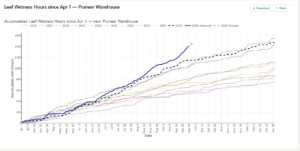
- The blue line is 2026. This is from ag-wx.com and is using our Pioneer warehouse location. Note how off-the-charts leaf wetness has been, not only all year, but especially since the beginning of August. Leaf wetness for 2026 has been high all year, but was just crazy wet over the last two months. This has played a big role in Tar Spot severity….
What’s New from Pioneer….
While Tar Spot is making us think hard about how to manage this disease, we are not without ‘tools-in-toolbox’. A couple of these tools are in Pioneer’s NEXTA lineup of biologicals:
NEW FROM NEXTA:
- Nexta Speedbox Advanced: Speedbox solutions for corn and soybeans. These pails are added directly on the seed at planting.
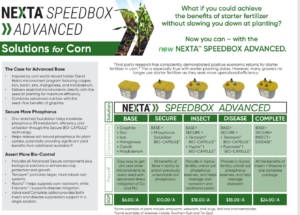
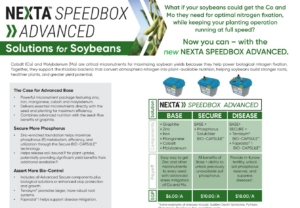
- These flyers show the Speedbox offering from NEXTA for corn and soybeans for 2027. The offering goes from the BASE speedbox on the left, with graphite and micronutrients, to the full COMPLETE speedbox on the right, with BASE + Phos stabilizer + Insect + Disease.
- We want to highlight the DISEASE speedbox. With the amount of Tar Spot in our area, this speedbox is something that growers should take a look at for 2027. It comes with Faprosta I for improved disease control on Southern Rust and Tar Spot. Research is showing an overall improvement to disease tolerance with this product. It has the potential to take a hybrid scoring a 5 for tolerance on Tar to a 6. Out of all of the speedboxes, this one appears to have the most value….see images below for a split trial with Faprosta and an early yield trial:
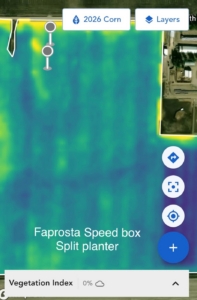
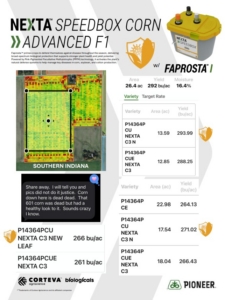 This bears a look at for 2027….
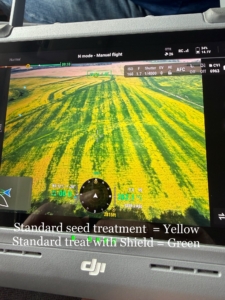
- NEXTA Shield Soybean Treatment. We will offering NEXTA Shield as a seed treatment for 2027. Shield is a key tool for early planted soybean acres, reducing early season cold stress, aids thru the V2-V3 stage of growth. Provides nutritional support with Cobalt and Molybdenum micros along with N molecule and soluble K. Pioneer is seeing good results on improving stands and early growth. See image below for split planter trial.

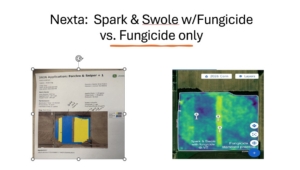
- The flyer above shows the complete lineup of biologicals from NEXTA for 2027. Image below shows results from Spark & Swole added to a fungicide treatment in 2026: Left photo is treatment date and application and right photo is satellite imagery of the treatment.
- VICTRATO: As mentioned at the plot tour, Pioneer offering Victrato in their Lumigen seed treatment lineup for soybeans. Victrato will control of for SDS and Red Crown Rot, replacing Ilevo in the lineup. Improves control of SCN over Ileveo. Research is showing a 1.5 bushel per acre advantage over current Ilevo treatment….without the Ilevo ‘burn’ on the cotelydon.
- Please reach out to us with any questions on these products and/or for more information about them.
All for now. Per usual, we will be texting out plot data as harvest progresses.
Please let us know any questions on hybrids, harvest priority’s, management, etc.
Please stay safe and have a successful harvest season!
Starman Seed & Supply, Inc.