
AGRONOMIC UPDATE: September 10, 2026….the End of the Season is here….

Topics:
- Growing Degree Unit Update/Weather Forecast
- Corn/Soybean Update
- Prioritizing Harvest…
TEMPERATURES & GDU ACCUMULATION:
As of September 9th, we have accumulated approximately the following for Growing Degree Units in 2026:
Planting Date GDD’s2026 Average GDD Departure from 30-yr average 2025
April 16 2796 2500 +296 (+14.5 days) 2600
April 21 2773 2470 +303 (+15 days) 2565
April 25 2703 2440 +263 (+12 days) 2540
May 1 2652 2420 +232 (+12 days) 2490
May 8 2644 2360 +284 (+14 days) 2400
Since the last update on Aug 24th (two weeks ago), GDU accumulation has continued to run above normal. We have gained three days plus days over the 30-yr average since the last update….just crazy to be two weeks ahead of normal. In fact, most of the April planting dates have accumulated enough GDU’s to mature hybrids from 114 day on down, with the May planting dates needing just a week or so to reach that level….according to GDU accumulation. However, as with most years, GDU accumulation outpaces actual crop development, which is usually a good thing for yield due to increased test weights and kernel depth. See map below to confirm the above numbers….the past two weeks have been close to record-breaking for heat.

This map shows the average temperature ranks by climate district over the past 10 days. Note that this time period was the 5th hottest out of 134 years for NE Nebraska. This has helped with GDU accumulation, but put late-season stress on plant health and staygreen, and is leading to increased disease severity, such as Tar Spot. Forecasts are predicting a potential pattern shift starting mid-month. Cooler temps and more precipitation are predicted. If this pans out, maturity on later-planted acres and overall crop drydown will be slowed.
Current Corn Conditions…..
- Current stage of much of the corn crop is as follows: Most fields are behind the above GDU accumulation. 105 day and earlier hybrids planted before April 24 are not quite black-layered, but very close – fuller season hybrids are strong 2/3 to 3/4 milk line. May 1 planting dates are 1/2 to 2/3 milk line. Fields heavily impacted by Tar Spot are very close to black-layer or are into drydown already. April planting dates should reach black-layer over next 3-5 days, with May planting dates needing 7-10 days, depending upon temperatures. Both grain color and kernel depth look very good at present, currently much better than last year; however, these next two weeks will still be important for final test weight and kernel depth. Even though one sees a ‘milk line’, there is not much milk left to squeeze out of the tip of the kernel. This could mean that the crop is further along than it indicates, and/or, these last two weeks of heat has impacted the last bit of grain-fill, and the tips are not filling fully to the end. Silage harvest is getting underway, and early indications are normal to above-normal tonnage, which is a good indicator of overall yields. However, will need to ‘get-after’ the silage as staygreen will be heavily impacted by Tar Spot. Bottomline on GDU accumulation for 2026, is that today we are looking at a corn crop as if it is Sep 17-20th, rather than a normal Sep 10th…
- Below are a couple of photos showing impact of kernel depth and test weight on final yield….
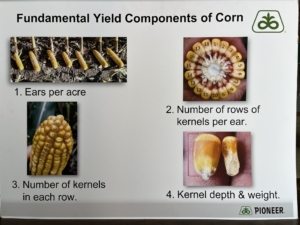
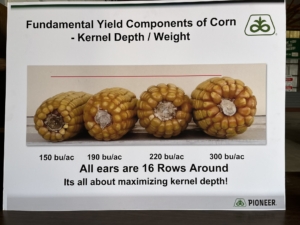
- Note the second photo showing size of ears. Note that all the ears are same rows around and kernel count, however kernel depth and weight is much different between the ears, with corresponding reduction in yield. Unless heavily impacted by disease or one of the recent wind events, kernel depth and color looks better than a year ago overall.
- Sunlight: Solar radiation for the past two weeks has been above normal. This should help on yield and plant health. However, this will be most helpful on those fields/hybrids that were able to maintain more green color over this time period. If the field was heavily impacted by Tar Spot, the increased sunlight will have limited impact, as the green-factory was shutting down too soon. As you’ve heard us over and over again, sunlight during grain-fill plays a key role in kernel depth and test weight, as well as overall plant health. August was below normal for sun, and had high humidity, both negatives to yield. So far, sunlight in September has been good.
- Disease: Tar Spot is the main disease for 2026 and is having a strong impact in our area. While Southern Rust was the main driver for disease issues in 2025, Tar Spot is this for 2026 and is prevalent in all area fields. The prior two years has really increased disease inoculum and this has now led to high levels of this disease in 2026. The sandy soils west of Elgin are getting hit the hardest, but all fields are changing now. Tar Spot is a fast mover late in the season and is showing this to be the case in our area. Tar Spot has really increased over the past two weeks and will eventually change all area fields to where, by the end of this month, most all area corn fields will no longer hold their green color. Some fields are brown now and have been for a couple of weeks. We will not see the long staygreen we have been accustomed too over the past few years, in 2026. On the other hand, while Southern Rust is in the area it came in late enough to not be a factor in yield. We will have more info on best management practices for this disease as harvest progresses and over the upcoming winter. However, the leading best-management practice for Tar Spot right now is hybrid selection and tolerance. Now is a good time to evaluate both hybrid tolerance as well as fungicide program/application method used….see photo below taken Sep 9….heavy soils, planted 4/22. One pass fungicide by plane w/Forcivo

-


- The above two photos show sand fields and the difference in Tar Spot tolerance between hybrids and companies.
- Importance of length of time of Leaf Wetness & Tar Spot: There are a lot of fields showing green dryland corners and brown circles now. This is all dependent upon hours of leaf wetness. The longer leaf is wet, the more pressure and the faster the development of Tar Spot will be. Photo below shows a N/S pivot road and the west and facing edges of that road. Note that the west facing edge has Tar Spot up to the ear leaf and the east facing edge has very little. This is due to the east facing edge drying out earlier in the day from the morning sun vs. west facing edge. Same hybrid…2 passes of fungicide….

- See link for a current field condition, taken Sep 8, 2026. Current Kernel Depth & Color – Sand field It will be curious to see if the kernel color can hold to the end, or if the plants are shutting down early from Tar Spot and won’t finish that last bit….note the difference between years on Tar Spot levels and remember that this link is from Sep 8 and the links below from 2025 were taken 11 days later.
- For comparison see links from 2025, first two taken Sep 19 on plant health, and third link on crop finish and test weights on Sep 29. P13777PCUE plant health P14830AML plant health Crop finish & Test Weights 2025
Prioritizing Harvest!
The extremes in weather (very dry conditions at planting and through July, along with temperature stress in July, followed by a foggy, wet, humid August, and then an oven to start September) in 2026 have the potential to impact late-season stalk quality. As mentioned above, diseases like Southern Rust & Tar Spot will have some of the biggest impact on stalk quality. Heavy fields Tar Spot will be likely to have poorer late-season stalk quality (already seeing this is some area fields). Stalk rots appear each year with varying degrees of severity. Watch for those fields that lose staygreen quickly, or that have ears drop suddenly, as these are signs of premature plant death. See photo for ‘ghost stalk’…..
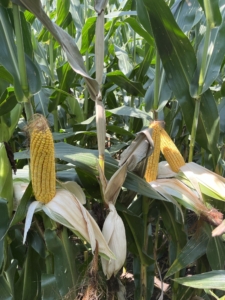
The statement, ‘the longer the plant stays green, the better the yield and standability will be during harvest’ still holds true; however, Tar Spot will be impacting the plants ability to ‘hold’ this….
-
- Bottomline, have harvest equipment ready to go now and be flexible to move from field-to-field and crop-to-crop depending upon late-season health, etc. If one has to chose between corn or soybean harvesting (taking into consideration the disease and plant health issues on the wind-event corn acres, and how heavy disease is present in a field), there is more risk in letting corn stand vs. losing soybean bushels from getting too dry. The 2026 harvest looks to be one to get done quicker than past years. 2025 ended up with good late-season standability considering the disease we had. We don’t think that will be the case in 2026. There is increased potential to have some corn fields needing to be harvested before soybean harvest is completed….some acres need to come out now. Those fields that have died over the past few weeks (are brown from the road) are running 22-28% in harvest moisture right now and plant health is deteriorating quickly, with ears starting to get rubbery…..This is one year where you want to be ready ‘to go’ at the first opportunity….equipment, labor, etc.
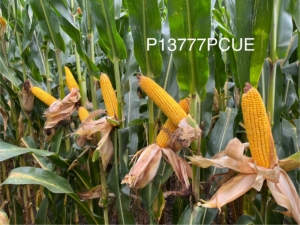
- Grain moisture drydown is dependent upon temperature and ear husk structure. On average, it takes 15-20 GDU’s to lower grain moisture each point from 30% down to 25%, 20-25 GDU’s per point of moisture from 25% to 22% and 25-30 GDU’s per point from 22% to 20%. A high of 75 degrees and a low of 55 degrees equate to 15 GDU’s, which should roughly take a point of moisture out per day when grain moisture’s are 25%+. So temps in the mid-70’s for highs and mid-50’s for lows should take corn from 30% to 25% in a week’s time. Forecasted temperatures for the next 10 days will give us 12-16 GDU’s/day….drydown will potentially be on the slow side for the rest of September by the looks of it. We have had fast drydown on the diseased corn acres due to the heat of the past 10 days.Another comparison photo…..P13777PCUE on heavy soils taken September 18, 2025. Shows how much ahead of normal we are for 2026, plus how much increased pressure from Tar Spot we have in 2026 vs. 2025. There are very few fields of P13777 in 2026 that look THAT clean right now….
- Soybean conditions & harvest:
- Soybeans are starting to turn in much of the area. Most fields are in mid-R6 to early R7. The early group II soybeans are really starting to turn now. Forecasted temperatures over next week or so will slow down development….
- Disease: Sudden Death Syndrome (SDS) is present in much of the area, with some fields showing heavy levels of infestation. Other than SDS, overall disease pressure in soybeans has been much reduced this year compared to prior few years.
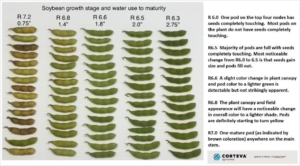
- Irrigation: Fields in the late-R6 to early-R7 stage need approximately 1.5-3″ of moisture to finish. For reference, the chart below shows soybean stage of growth at R6-R7. Don’t give up on that last watering…..many fields are still green yet….
- Expect soybean harvest to fall within the ‘normal’ time frame as they are photoperiod dependent and not really driven by GDU accumulation. With the future forecast, soybean harvest will most likely be delayed from what we were first expecting….
- Weather conditions forecasted over the next two weeks are indicating a potential pattern change of cooler and wetter weather. This will slow crop drydown and potential soybean harvest.
Please let us know any questions, or concerns, or comments you may have. Let us know how we can help as harvest gets going! Stay safe! Thanks for your support!
Starman Seed & Supply, Inc.