HARVEST UPDATE: November 5, 2026….A Fight to the End….
The 2026 harvest season is ‘one-for-the-books’, and not in a good way. It has been a fight from the beginning to get the crop out and it looks to be a fight to the end. Many factors have contributed to this, such as weather conditions, down corn, grain quality & condition (especially soybeans), among others, all of which is greatly influenced by environment. And, as we know already, environment has the greatest impact on final yield, both in what is produced in the field and what we are able to harvest out of the field. We can ‘do everything right’ to the best of our ability, but Mother Nature has final ‘say’ on how ‘what we do’ turns out. This has led to the most trying harvest conditions in recent memory and beyond. Which leads to the question of why….why is this year so different from prior years?….and what can we do to keep this from occurring next year and beyond? This update will try to explain some of the ‘why this happened’ and provide some management ideas to think about for 2027.
Quick Takeaways:
- Irrigated corn yields variable, better than last year in some cases….still off in others….and that’s not counting the down corn.
- Dryland corn yields good in heavy soils….rains didn’t come soon enough in most sand….
- Soybean yields, both irrigated and dryland…above-to-much above normal…to best ever….
- Fastest GDU accumulation in 30+ years….2012 next closest.
- Shortest grainfill period for a number of years….KEY to what happened at harvest
- Hot & Dry through pollination and early kernel set…
- Warm nights during grainfill….
- Sunlight good through pollination, but below normal during grainfill…
- Rain arrived late….
- Tar Spot really came on late….
- Late September….wet, humid spell caused increased soybean seed discoloration.
PERFECT STORM….Weather Stresses…
We are getting tired of using this title, as it seems every year Mother Nature gives us a ‘perfect storm’ of stress. And yet, 2026 was a year of extremes as far as weather was concerned. As in every year, there is no one single cause for the yields we are seeing this year; however, 2026 gave many different stress events, from beginning to the end of the year and each stress compounded the other as the year progressed, and these stresses went from one extreme to the other. No two years are alike, and this proved true for 2026.
A TALE OF THREE YEARS….
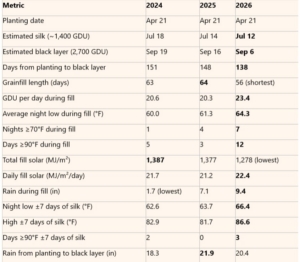
Chart below shows a comparison between the years 2024, 2025, & 2026 for some of the major weather metrics. This data is using a planting date of April 21st and uses a 2700 GDU hybrid (113 day). As you look at this chart, keep in mind that 2024 had great yields across all soil types….the most 300bu weighs we have had in one year, though it had heavy Southern Rust and minimal Tar Spot….2024 saw better overall yields on a general basis than either 2025 or 2026….and some of those fields in 2024 had no fungicide applied to them….
What this meant for yield and plant health:
- 2026 had the Fastest GDU accumulation & Shortest Grainfill period out of the three years. Crop reached black layer about 10-13 days ahead of 2024 and 2025 and 2026 had the most 90+ degree days and 70+ degree nights…..note the spike during pollination for both high and low temps. This put extra stress on the crop versus 2024 & 2025.
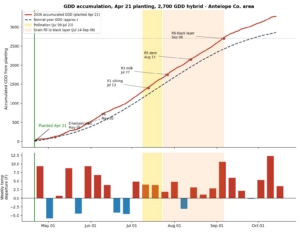
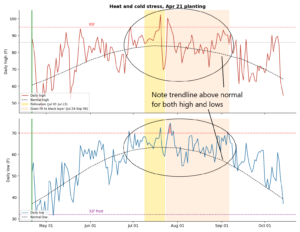
Corn crop was being ‘pushed’ throughout the growing season. Note the above trendline starting in May already. Note also the above normal highs and lows for all of the grainfill period for 2026 in the second graph.
- Warm Nights: 2026 had the warmest nighttime temperatures out of the three years. Warm nights lead to higher energy loss by the plant which causes increased stress under reduced sunlight and moisture conditions. See graphs below for 2026 & 2024:
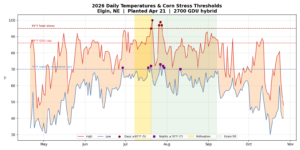
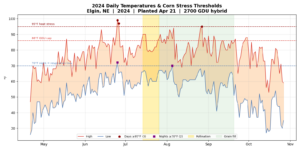
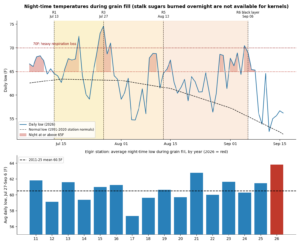
They backup the earlier slide on average highs and lows from above. Note that 2026 saw the highest nighttime average low temperature during grainfill in the last 15 years….note also the cooler temperatures in 2024 vs. 2026. All of this leads to higher demand for water, nutrients, photosynthesis at the most critical period of corn development….
- Sunlight: 2026 had the least sunlight during grainfill out of the last three years. Sunlight is so important to yield and plant health! Sunlight was good up to and through pollination, but fell off in August/September. Overall sunlight was also down due to shortened grainfill period leading to reduced energy production, which leads to poorer late-season plant health.
- Precipitation: Note that 2026 had the highest grainfill precipitation out of the three years. This is always a key in soybean production, but can be a detriment to irrigated corn (not so much in yield, but in overall plant health) as increased rainfall leads to an increase in potential for damage from storms, cloudier weather, more leaf wetness hours, etc., which leads to increased potential for disease. Graph below compares precipitation from planting for 2025 and 2026.
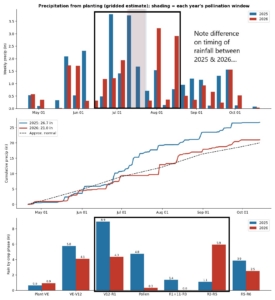
Big difference in timing of precipitation between 2025 and 2026. 2025’s rainfall came early in the growing season, with consequent reduced plant biomass/root growth and N loss. 2026 was very dry early and through pollination leading to good plant biomass and better root growth; however, the later rainfall increased potential for more stress under high yield irrigated conditions from disease, etc., especially with the warm nights we experienced.
- Tar Spot & Leaf Wetness: As expected, Tar Spot grew in severity for 2026 as inoculum continued to build up over last couple of years. 2026 saw heavy Tar Spot and it left its impact on yield by causing pre-mature leaf loss and plant death, which directly impacted yield through loss from down corn. Tar Spot is not THE cause for down corn, but it played a major role in it by speeding up leaf loss, contributing to less late grainfill energy production that normally goes into providing late-season plant health. Tar Spot also caused yield loss without down corn in susceptible hybrids, through premature death occurring already in August. Why was it so bad this year?
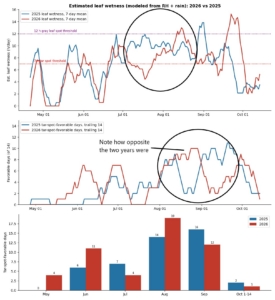
The above graph shows a comparison for estimated hours of leaf wetness, and favorable days for Tar Spot development, for 2025 and 2026. As with any disease, but even more so with Tar Spot, hours of leaf wetness are critical for how severe disease infestations will be. Note how opposite the two years are from each other, especially in Tar Spot favorable days. This is directly related to the increased precipitation mentioned above, but also note how early Tar Spot favorable days started in 2026 vs. 2025, and then note how long of a period of favorable days we had through the month of August for 2026. All of this led to a high outbreak of Tar Spot which allowed it to get established and really take-off late in the season, killing off leaf area. Couple this with the foggy, cloudy, damp days in August and late-September, and Tar Spot was able to quickly develop and spread under irrigated conditions. See below graphs for comparison to 2026 and 2024.
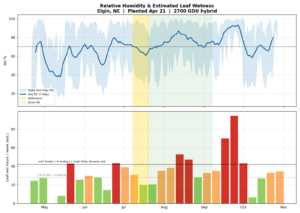
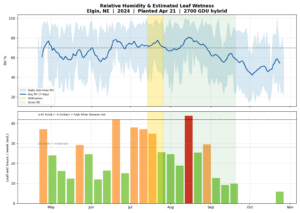
Note how relative humidity stayed high throughout the month of August for 2026 versus 2024, and note the amount of red favorable days between the two years. Keep in mind that, while Tar Spot is a major factor moving forward in corn production for our area, it is not a ‘given’ that it will be this bad from year-to-year….that is dependent upon weather conditions, especially in August/September. A point to keep in mind, is that 2025 saw high levels of Southern Rust along with Tar Spot and yet plant standability was good overall late into harvest….
- Bottomline:
- 2026 setup for high irrigated yields heading into grainfill….while dryland looked bleak…
- We achieved high irrigated yields, but at the expense of plant standability (not enough energy to produce both high yield and late-season plant health)….
- Dryland pulled through with late rains….and stood better through reduced populations and reduced leaf wetness from thinner plant canopy.
- On top of shortened grainfill period, Tar Spot put the finishing touches to trying to maintain some staygreen and plant health late, leading to cornfields by the end of September look like they do on the 1st of November. In many ways, Tar Spot is like someone with an already weakened immune system contracting Covid and then Covid killing them….same for the corn plant, it was already weakened from other stresses during the year and Tar Spot was the final event that ‘pushed them’ over the edge.
- Intensive management under irrigation, such as high populations, high fertility/manure, narrow rows, cause their own stress, and under less than ideal conditions during grainfill those stresses are compounded. This is why some of the more intensively managed irrigated acres saw increased down corn. Any additional ‘normal’ management practices, such as corn-on-corn acres, can come with their own stresses, which are then compounded as well, under a grainfill period like we saw in 2026.
- Importance of grainfill period: 2024 had the best grainfill period (more consistent) over the past three years….cooler temperatures….greater sunlight…less moisture, less storm damage, less clouds consequent drier plant canopies….hence the higher yields. We saw fields in 2024 that had no fungicide applications and heavy southern rust still yield 260-280 bushel averages. Yield is as much weather conditions at grainfill (especially month of August) as is about potential disease pressure….
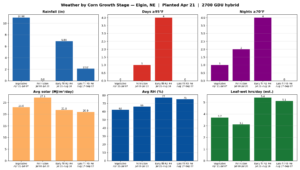
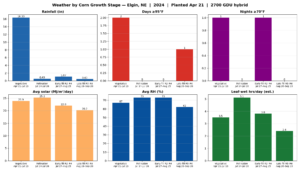
The above bar graphs show weather by growth stage for 2026 and 2024. Note again the differences in timing of rainfall, temperatures, relative humidity and hours of leaf wetness between the two years, keeping in mind yield and standability between the two years….
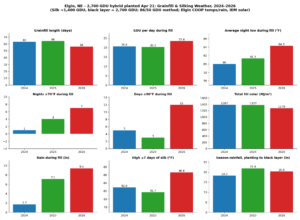
The above bar chart shows grainfill and silking weather comparing 2024, 2025 & 2026. This just summarizes what was discussed above.
THOUGHTS HEADING INTO 2027….
While harvest conditions are making it difficult to arrive at ‘solid’ conclusions when looking at harvest data and hybrid plots, there is still much we can get out of this years production.
- Managing for 2027:
- Tar Spot – First line of defense is hybrid/genetic selection. Those hybrids that showed the best tolerance to Tar Spot (even though they still went down) had better yields than those hybrids that were more, or very, susceptible to Tar Spot. Starting with a good foundation for protection (just like having a healthy immune system before onset of disease) helps fight off the disease and makes any management of these disease through fungicide applications, etc., easier and more cost-effective. Not starting out with a healthy immune system when contracting a disease, leads to higher costs and less effective treatments.
- One-pass or Two-pass fungicide applications: On a general basis, seeing a positive yield response to a second fungicide application over one-pass application….anywhere from 5-30+ bushels…though not on every field. No general consensus on timing or application method so far….seeing all timing and method of applications show poor standability and less-or-more yield. There is no ‘one-blanket’ statement to be made on timing or method of application from our observations….
- Keep all tools in the toolbox: Don’t be ready to discard a management practice that you have been doing just because of one year. It is best to keep all tools handy, including some new ones, like Speedbox planter treatments, adjusting plant populations where needed, trying new ways to improve irrigation management to reduce leaf wetness, and other ideas, will be key to getting consistent results in 2027.
- ‘Right product, Right Acre’ – still holds true. Putting the right hybrid/variety for the right acre carries the best chances for highest yields. Managing for drought, disease, early-planting, etc., are still key to consistent performance.
SOYBEAN YIELDS: As mentioned at the start of this newsletter, soybean yields overall were above average to well-above average. A lot of mid 70’s to mid’90’s field averages, and this was with all the discolored soybeans from the damp, cloudy weather experienced during the last two weeks of September. The rains received in August went A LONG way to making these yields. Soybeans again showed very good response to April planting dates.
More information and local plot data to follow over the next week or so….
Here is a line pulled from the 2025 harvest update:
“The most true statement heading into 2026 is that no two years are alike weather wise….July 2025 will not be the July of 2026….”
How very true that statement was, as July 2026 was very much unlike July 2025….so it will be in July/August 2026 vs. 2027….
Please contact with any questions or comments you are seeing as harvest continues.
Thank you for your business and support!!
Have a continued safe and successful harvest!
Starman Seed & Supply, Inc.