
AGRONOMIC UPDATE: June 11, 2026…..Taking off….
TOPICS FOR THIS UPDATE:
- Temperatures & GDU accumulation
- What’s going on in my fields right now…
- Insect Update
- Soybean Update
TEMPERATURES & GDU ACCUMULATION:
As of June 9th, we have accumulated approximately the following for Growing Degree Units in 2026:
Planting Date GDD’s2026 Average GDD Departure from average 2025
April 16 747 595 +152 602
April 21 704 565 +139 568
April 25 644 536 +108 538
May 1 635 497 +138 458
May 8 571 435 +136 405
As one can see from the above numbers, the pace of GDU accumulation has really taken off the past 2-3 weeks. We have accumulated 500 GDU’s since the last update on May 13th. That is above normal for this time of year. Contrast this with the GDU accumulation for 2025. 2025 was warmer than 2026 early, but turned cooler in late-May/early-June versus this year. No two years are alike….
The GDU accumulation continues to show the three planting windows that was mentioned in the last update:
- First window: April 14–23 – Best overall plant stands and uniform emergence and height.
- Second (mid) window: April 24–May 5 – Weaker plant stand, more unevenness in height and color.
- Third window: May 6-13 – Good plant stands and uniformity in emergence and height again.
Note that each planting window is above average in GDU accumulation..
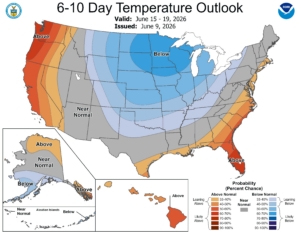
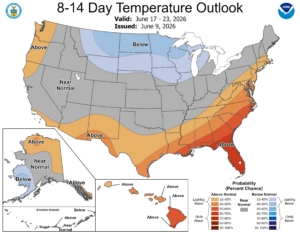
The corn crop has really grown over the past few weeks. However, temperatures are forecasted to cool off over the next 10-14 days as we see in the maps below:
WHAT’S GOING ON IN MY FIELDS RIGHT NOW?...
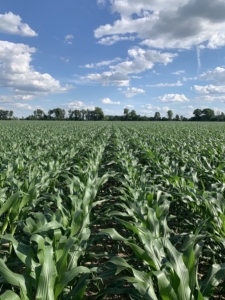
The majority of the corn crop is in the 5-8 leaf stage. From V1-V10, corn gains a leaf collar about every 83 GDU’s…this will be about every 4 days with current forecasted conditions. This would put us in the mid-July time frame for tasseling….slightly earlier for first planting window and slightly later for last planting window. Final stands are good overall, but consistently off 1-3k, especially in the no-tilled fields.
- At V5, leaf and ear shoot initiation will be complete and a microscopically small tassel is initiated in the stem apex tip, or top of the growing point.
- At V6, the growing point and tassel will be above the soil surface and the stalk is beginning a period of greatly increased elongation.
- Determination of potential kernel rows around will be completed around V7 (range of V5-V8)…all fields are now is this stage….
- The corn root system is now rapidly transitioning to the main nodal root system. When hot temperatures occur following a cool spell, crop growth at this stage can be uneven. Areas of heavier residue are looking shorter in plant height. It will take a little time for that to catch up. We are experiencing this right now. Many area fields are showing an ‘off color’ and uneven plant height in clay hillsides and lighter sand areas. This is due to poorer root-to-soil contact in these areas, as soil structure (both density and pore space) is still messed up due to the dry conditions we have experienced since last winter. And, even though we have received close to normal rainfall for June in most areas, our soils are still ‘dry’ at present time. See maps and chart below:
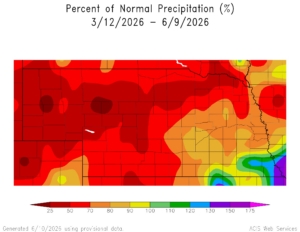
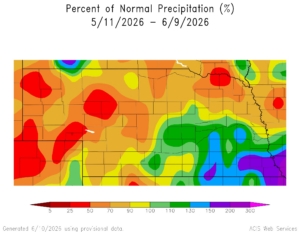
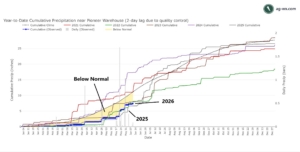
- The first map is percent of normal precipitation for Nebraska from mid-March to now. We are still only 60-70% of normal. The second map shows that the past month has helped, but we only received 80-90% of normal over the past 30 days. The chart shows year-to-date accumulative precipitation for Elgin for 2026 versus normal and prior five years. Note the below normal deficit shown in yellow, as well as the similarities and differences between 2026 and 2025. It was about this time last year that moisture really set in….will it happen again in 2026?….
- Bottomline, many fields are still on the dry side and somewhat hard in the upper foot. See video link below for more info….
- Topsoil still on the dry side….
- Another difference in 2026 vs. 2025 so far, is that overall plant height is greater currently than in 2025, and canopy closure will happen quicker because of this, for 2026 vs. 2025. Plant internodes were stacked close together last year….we are not seeing quite the same for 2026 crop year.
- At V9, an ear shoot will develop from every above-ground node, except the las six to eight nodes below the tassel. Growth of most of the lower stalk ear shoots eventually slows, and only the upper one or two ear shoots will develop into a harvestable ear.
- At V10, the time between the appearance of new leaf stages will shorten….generally every 2-3 days.
- We are now heading into the rapid growth and accumulation of dry matter by the plant. The window for brittle snap will start to grow exponentially over the next few weeks.
- Pre-emerge herbicide control has been very good in both corn and soybeans considering the early, dry conditions. Rainfall received over last few weeks has really helped here. Palmer is really starting to come over last couple of days, so be scouting now for any potential respray as the window for application in corn is closed for April planting dates and closing quickly for May planting dates.
- Watch temperatures as you are spraying post-herbicides on corn or beans. When temps are in the 90’s and humidity is very low, (or very high), the potential for crop response from post-application of herbicides will increase. It is not recommended to be spraying during the heat of the day if temps are in the low-to-upper 90’s…both for potential crop response and herbicide control. Contact only herbicides like Liberty need full sun, warm temps and high humidity for good control.
- Post-N applications should be on, going on, or going on shortly. Crop that has reached V7-V9 in these growth conditions should have 100-120# of N applied to keep it happy under good growing conditions. Keep in mind also, that, if conditions stay dry, more water will be needed to push the N into the rootzone, .30-.40″ won’t be enough to get it fully moved into the active rootzone.
INSECT UPDATE:
Corn Rootworms –
Corn rootworm hatch should be ahead of average for 2026. When we see the cotton start to fly, or the famous lightning bugs, we will know rootworm hatch is underway because it takes about the same GDU’s (680-750 soil based degree days) for all of these things to happen….cotton has been flying for awhile now….
Some CRW facts:
- Larvae in sandy soils can become scratched and lacerated causing more mortality
- Flooded or saturated soils will cause more mortality….something we have not had last two years in the spring or at hatch.
- CRW will go through 3 growth stages (Each last 7-10 days)
- 3rd Instar will create the most damage to corn roots
- Begin scouting continuous corn acres now through the rest of the month of June.
There are many management practices that can help mitigate the risk of yield loss or lodging due to corn rootworm. The best recommended strategy is to rotate to soybeans. Overall pressure was higher in 2025 than prior few years, so hopefully, so expect to see good survivability for rootworm larvae. The new Vorceed Enlist technology from Pioneer is a new ‘tool’ in the toolbox for CRW control. Vorceed offers three distinct modes of action for protection against CRW, with 98% reduction of adult beetle emergence. If you planted a hybrid with a number that ended with a V (ie. P13777V example), that hybrid has the Vorceed technology.
Corn Rootworm Scouting and Management
European Corn Borer:
- We are just starting to see ECB moths flying this week. For those of you who have conventional white or yellow corn and/or popcorn, begin scouting for this pest the end of next week and scout over next few weeks, cooler temperatures will slowdown moth flight and egg laying. We will keep everyone updated on this pest….
- On premium priced acres, treat at 5-10% infestations.
Wheat Stem Maggot in Corn

- Rare pest, but possible when corn follows rye cover. Have not seen much of this in our area so fare, but we are hearing reports in counties south of us of reduced plant stands from this pest.
- Maggots feed in green stems of rye – when rye crop dies, they move into emerging corn.
- Symptoms in Corn:
- Dead center whorls
- Stunted growth
- Excessive tillering
- Timing: highest risk when cover is terminated after corn is planted. It is possible that early GDU accumulation may have ‘pushed’ the insect into being able to cause damage before the rye cover was terminated. May want to consider applying an insecticide when terminating the crop….still a rare pest….however, with rye cover acres increasing, expectations are for this pest to increase as well.
- No rescue options.
SOYBEAN UPDATE:
- As was the case in 2025, most soybeans were planted by first week of May this year.
- For the most part, soybean stands are adequate to good, even with the three different frost events this spring. Tilled fields struggled a little more with stands due to the tillage ‘fluffing’ the soil up more, leading to less than ideal seed-soil contact….caused by the dry soil conditions.
- Many no-tilled fields have the ‘usual’ look to them of uneven growth and color. Much of this is due to soil structure conditions at planting and after….worse in the heavier residue, again very typical for no-till.
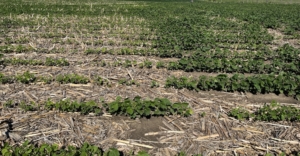
- While an exaggerated area, photo shows the growth difference in between heavy residue and bare soils in no-till soybean fields. This is exacerbated this year due to the open, dry winter and spring and cooler soil temps in the residue areas. This gets magnified when we get good heat to spur growth.
- We continue to see good response from Lumiderm insecticide seed treatments. Plant populations are consistently higher and more uniform when this product is used at early planting and tilled soils. See video link for more info….Lumiderm insecticide may have helped here….the fluffed up soil from the tillage also played a role….
NEXTA Biologicals for Corn and Soybeans
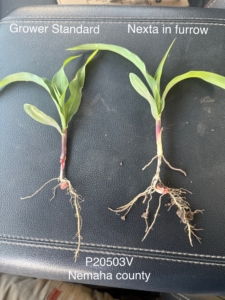
NEXTA is the brand name for Pioneer’s lineup of biological products. Nexta Stand & Shield are products that have a mixture of growth hormones that promote plant growth under stress conditions. These products can be tank-mixed with your post-application of herbicide. This is a product that can help with uneven growth and heavy residue fields, which is what we are experiencing right now. Photo below is on corn, but effect is the same for soybeans.
- Most all soybean fields in the area are the stage where it will be time for a post-application of Enlist or Enlist/Liberty….some should be sprayed already….
- Maximizing Enlist Applications
- Nozzles – TeeJet AIXR or AI-TTJ
- Pressure – run in the high end of your nozzle’s pressure range
- GPA – 20 GPA minimum with Enlist/Liberty
- Enlist can be sprayed through R1 soybeans
- Liberty Timing Tips:
- Spray after dew is gone
- Stop 2 hours before sunset
- Ideal conditions are 70-85F, sunny and higher humidity.
- No insect concerns in soybeans at present time.
Please reach out to us with any questions or concerns you may have. Stay safe! Thank you for all of your support!!
STARMAN SEED & SUPPLY, INC.